
Godrej Smart Sync AC 2026: AC + Fan Saving Guide
A practical 2026 guide to using Godrej Smart Sync-style AC and fan operation wisely in Indian homes, with bill math, settings, checks and savings limits.
Godrej Smart Sync AC 2026: AC + Fan Saving Guide
TL;DR: A Godrej Smart Sync AC + fan setup can help many Indian homes feel comfortable at a higher AC temperature, especially at night, but the saving depends on your room, tariff, usage hours, BEE rating and how sensibly you run the fan. Do not expect magic 50% bill cuts. Use the AC at around 24–27°C with a ceiling fan on low or medium speed, keep doors/windows sealed, clean filters, and compare actual BEE ISEER values before buying.
Last updated: July 2026
Key takeaways
- A ceiling fan does not cool the room air; it improves skin-level comfort by moving air, allowing many people to set the AC temperature 1–3°C higher.
- The biggest possible saving comes from reducing compressor load, not from the fan itself. A typical ceiling fan may use around 25–75W, while a 1.5 ton inverter AC may draw several hundred watts to over 1 kW depending on heat load.
- Godrej Smart Sync-related features should be treated as comfort and control tools first. Verify the exact model page, remote/app functions and compatibility before paying.
- For Indian bedrooms, the best practical starting point is often AC at 25–26°C, fan at low/medium, sleep/timer mode on, and filters cleaned every 2–4 weeks in dusty months.
- Savings are lower in leaky rooms, west-facing rooms, top-floor flats, kitchens nearby, or when the AC is set very low such as 18–20°C.
- Buy based on tonnage, BEE star rating, ISEER, copper installation quality, warranty terms and local service support—not only on “smart” marketing.
Table of contents
- What Smart Sync AC + Fan Use Means in a Real Indian Home
- How AC + Fan Operation Can Save Electricity
- Bill Math: What Savings May Look Like
- Choosing the Right Godrej AC: Tonnage, Star Rating and Room Size
- Best Settings for Bedrooms, Halls and Work-from-Home Rooms
- Buying Checklist for Smart Sync or Connected AC Features
- Installation Points That Affect Savings More Than Apps
- Common Mistakes with AC + Fan Use
- Maintenance Routine for Better Cooling and Lower Bills
- Practical Next Steps
What Smart Sync AC + Fan Use Means in a Real Indian Home
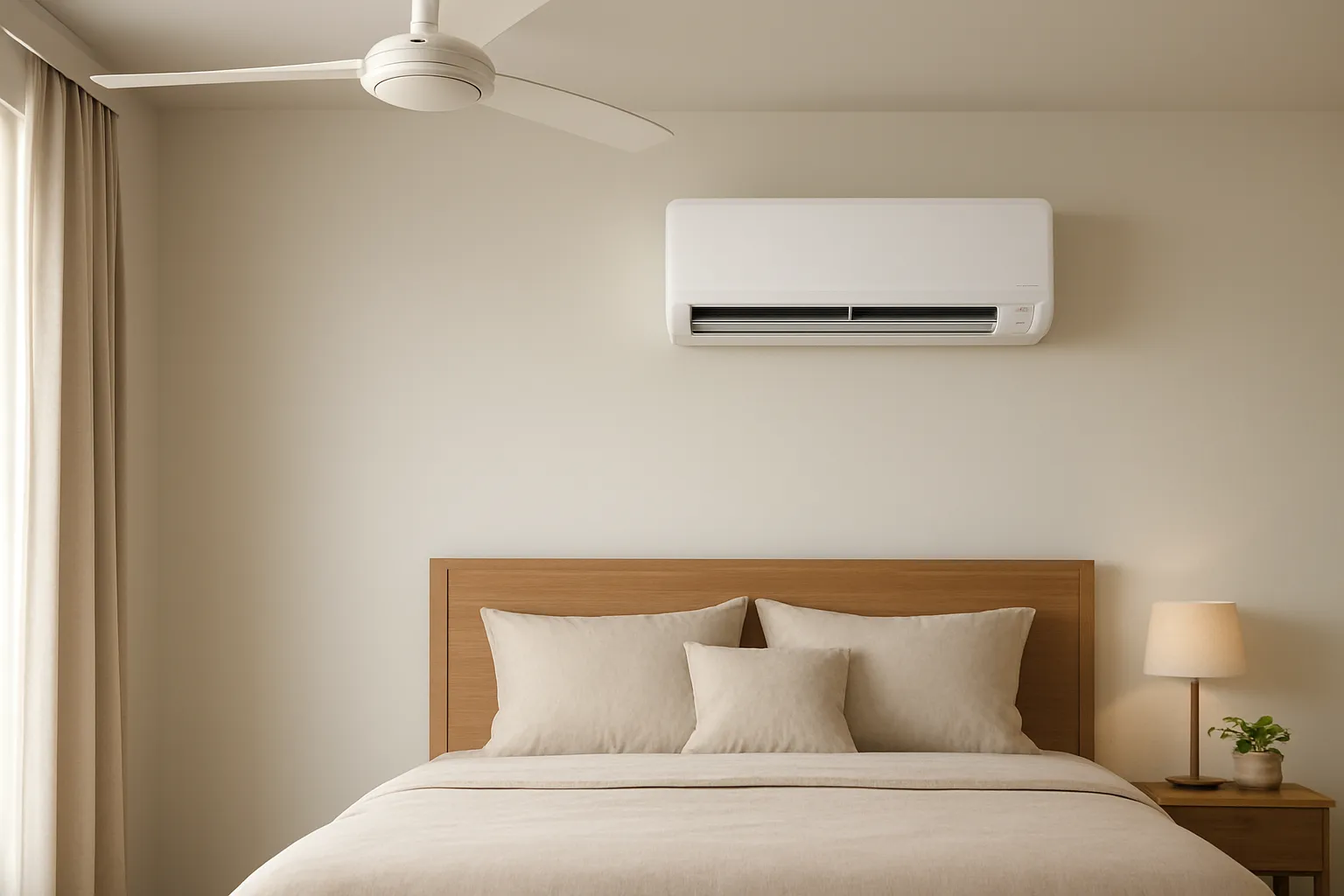
The idea behind a Godrej Smart Sync AC + fan saving setup is simple: use air movement from a ceiling fan along with air cooling from the AC so the room feels comfortable without forcing the AC to run at a very low set temperature. In many Indian homes, this is more practical than running the AC alone at 20–22°C through the night.
The exact meaning of “Smart Sync” can vary by product generation and retail listing. On some connected cooling products, smart features may involve app control, scheduling, remote access, voice assistant compatibility, energy monitoring, or coordinated operation with compatible devices. Before you buy, check the official Godrej Appliances model page or the latest product brochure for that exact model number. Do not assume that every Godrej inverter AC supports the same smart functions.
For a household, the useful question is not only “Does it have Smart Sync?” but also:
- Can it help maintain comfort at 25–27°C?
- Is the fan speed adjustable enough for night use?
- Does the AC have reliable sleep mode, timer and temperature control?
- Is Wi-Fi/app control stable in your home network?
- Can local service technicians handle this model if the PCB, sensor or remote module fails?
In Indian conditions, the AC + fan approach is most useful in bedrooms and living rooms where people stay for long hours. It is less effective when the room has open doors, frequent heat entry, a large glass wall, direct afternoon sun, or heavy cooking heat.
How AC + Fan Operation Can Save Electricity
An AC removes heat and humidity from the room. A fan only moves air. This difference matters because a fan cannot replace an AC in peak summer, but it can make the cooled air feel more comfortable.
When air moves across your skin, sweat evaporates more easily and the body feels cooler. Because of that, many people can increase the AC set point from 22–23°C to 25–26°C and still sleep comfortably. That higher set point can reduce compressor work, especially on inverter ACs that modulate output instead of switching only on and off.
The saving logic is:
- Set AC slightly higher.
- Use ceiling fan at low or medium speed.
- Room feels comfortable due to air circulation.
- AC compressor does not need to work as hard.
- Over many hours, kWh consumption may reduce.
This works best with inverter ACs because they can slow down after the room reaches the set temperature. A fixed-speed AC can also benefit, but it may cycle on and off more sharply. The exact result depends on insulation, outdoor temperature, indoor heat load and humidity.
A fan also helps distribute cool air. In many rooms, the area near the indoor unit becomes cold while the bed or sofa corner remains warmer. A ceiling fan on low speed can mix the air gently, reducing hot pockets. However, very high fan speed may feel draughty, dry the throat for some users, or make the room feel uneven if the AC airflow is poorly directed.
Bill Math: What Savings May Look Like
Electricity tariffs in India vary by state, slab, fixed charges and time-of-day rules. In many urban homes, an approximate all-in energy cost may fall anywhere from ₹6 to ₹12 per kWh, and sometimes higher in upper slabs. Use your own bill for accuracy.
Let us take a realistic example for understanding, not a guaranteed saving claim.
Example: 1.5 ton inverter AC in a bedroom
Assume:
- AC type: 1.5 ton inverter split AC
- Room: 130–160 sq ft bedroom
- Usage: 8 hours per night
- Tariff: ₹8 per kWh
- Fan: BLDC fan around 30W, or regular fan around 60W
If the AC alone averages 0.9 kW through the night at a low set temperature:
- 0.9 kW × 8 hours = 7.2 kWh per night
- 7.2 × ₹8 = ₹57.60 per night
- For 30 nights: about ₹1,728
Now suppose you set the AC 2°C higher and use a fan. The AC average draw may reduce depending on conditions. If it averages 0.75 kW and the fan uses 0.05 kW:
- AC: 0.75 × 8 = 6.0 kWh
- Fan: 0.05 × 8 = 0.4 kWh
- Total: 6.4 kWh per night
- 6.4 × ₹8 = ₹51.20 per night
- For 30 nights: about ₹1,536
Approximate monthly difference: ₹192 in this example.
In a hotter room, saving may be lower. In a well-insulated room where the AC can reduce compressor speed smoothly, saving may be better. If you use an old high-wattage fan at full speed and do not increase the AC temperature, you may save nothing and may even consume slightly more.
Why savings claims should be treated carefully
Some ads and shopping pages use broad terms like “energy saving”, “smart cooling” or “AI mode”. These do not automatically mean lower bills in your home. The reliable numbers are:
- BEE star rating for the current rating period
- ISEER value
- Cooling capacity in watts
- Annual energy consumption figure on the BEE label
- Your actual usage hours and tariff
For a Godrej Smart Sync AC fan saving guide, the safest approach is to use the fan to raise temperature comfort, not to run both devices aggressively.
Choosing the Right Godrej AC: Tonnage, Star Rating and Room Size
Godrej typically sells split ACs across common Indian capacities such as 1 ton, 1.5 ton and 2 ton, with inverter and non-inverter options depending on the season and model lineup. Exact availability changes, so check 2026 listings and the official BEE label before purchase.
A rough room sizing guide for average Indian conditions:
| Room condition | Approx room size | Suggested capacity starting point | Notes |
|---|---|---|---|
| Small bedroom, limited sun | 90–120 sq ft | 1 ton | Good for one or two occupants if insulation is decent |
| Typical bedroom | 120–170 sq ft | 1.5 ton | Most common choice for Indian bedrooms |
| Large bedroom or small hall | 170–220 sq ft | 1.5 ton high capacity or 2 ton | Consider sun exposure and ceiling height |
| Top-floor/west-facing room | Add heat load | Often one step higher | Curtains and roof insulation can reduce required load |
| Open living area | Varies widely | Site assessment preferred | Open kitchens and staircases increase load |
Do not buy only by square feet. A 150 sq ft room on a middle floor in Pune may need less cooling than a 150 sq ft west-facing top-floor room in Jaipur or Nagpur. Similarly, a shaded bedroom in Bengaluru may behave very differently from a glass-heavy room in Delhi NCR.
For star ratings, compare 3-star and 5-star inverter models based on your usage. If you use AC only for 1–2 hours occasionally, the extra price of a 5-star model may take longer to recover. If your bedroom AC runs 8–10 hours nightly for several months, a higher ISEER model can make more sense.
Approximate price ranges in 2026 can vary widely by sale, installation package and city. As a broad market observation, 1.5 ton inverter split ACs from major brands may often fall in the ₹32,000–₹55,000 range, with premium connected or 5-star models costing more. Treat this as approximate; verify current prices before buying.
Best Settings for Bedrooms, Halls and Work-from-Home Rooms
The right AC + fan setting depends on activity level. A person sleeping under a sheet needs different airflow from someone working near a laptop in the afternoon.
| Use case | AC temperature | Fan speed | Extra tip |
|---|---|---|---|
| Night sleeping | 25–27°C | Low or medium | Use sleep mode/timer and avoid direct AC blast on the face |
| Afternoon work-from-home | 24–26°C | Low/medium | Close curtains before peak sun hits the room |
| Living room with guests | 23–25°C initially, then 25–26°C | Medium | Pre-cool for 20–30 minutes if people are arriving |
| Humid coastal city | 24–26°C | Low | Dry mode may help sometimes, but monitor comfort |
| Elderly family members or children | Comfort-based | Gentle airflow | Avoid extreme cold and strong draughts |
A good routine is to start the AC at 24°C for the first 20–30 minutes if the room is very hot, then raise it to 25–26°C once the walls and furniture begin cooling. Keep the fan on low or medium instead of full speed. Full-speed fan can feel noisy and may disturb sleep.
If your Godrej AC has sleep mode, eco mode, timer or app scheduling, use them. A timer that switches off the AC at 4–5 a.m. and keeps the fan running can work in some cities during mild nights. In very humid places, turning the AC off too early may make the room sticky, so test gradually.
Buying Checklist for Smart Sync or Connected AC Features
Smart features are useful only when they solve your daily problem. Before choosing a Godrej Smart Sync-compatible or connected AC, ask the retailer for the exact model number and verify feature details.
| Checkpoint | What to verify | Why it matters |
|---|---|---|
| Exact model number | Match box, invoice and official listing | Similar names can have different features |
| BEE label year | Current rating period and ISEER | Old stock may have older rating data |
| Smart feature details | App, Wi-Fi, scheduling, remote control, fan sync if supported | Avoid assuming all models have the same function |
| Fan compatibility | Whether it needs a specific smart fan/controller | Some functions may not work with ordinary fans |
| Warranty | Comprehensive warranty, compressor warranty, PCB terms | Smart/inverter electronics can be costly to repair |
| Service network | Godrej service availability in your PIN code | Fast support matters during summer |
| Installation package | Copper pipe length, stand, drain pipe, core cutting, wiring | Hidden installation costs can change total price |
If the salesperson says “AC and fan will automatically save electricity,” ask how. Does the AC raise the set temperature? Does it control fan speed? Does it only allow app-based automation? Is an additional Godrej smart fan, hub or module required? Clear answers prevent disappointment after installation.
Also check Wi-Fi reliability. Many connected appliances need a stable 2.4 GHz Wi-Fi network. If your router is far from the bedroom or frequently disconnects, app features may be less useful. The AC should still work properly from the normal remote.
Installation Points That Affect Savings More Than Apps
A well-installed 3-star AC can sometimes perform better in real life than a badly installed 5-star AC. Installation quality affects cooling speed, compressor stress, water leakage and electricity use.
Important installation checks:
- Outdoor unit should have open airflow, not be boxed into a tight balcony corner.
- Indoor unit should not be placed directly above a wardrobe or blocked by curtains.
- Copper pipe length should follow manufacturer limits and be properly insulated.
- Drain pipe should have correct slope to avoid leakage and smell.
- Vacuuming the refrigerant line during installation should not be skipped.
- Electrical wiring should be suitable for AC load, with proper earthing.
- Stabilizer requirement should be decided based on local voltage conditions and model specifications.
In many Indian apartments, the outdoor unit is installed in a service shaft with poor ventilation. This can raise operating pressure and reduce efficiency. If possible, choose a location where hot air can escape easily. If your society has fixed outdoor unit positions, keep the area clean and avoid covering the condenser tightly with decorative panels.
For AC + fan comfort, the ceiling fan position also matters. If the fan is not centered over the bed or seating area, airflow may not help much. If you are renovating, place the fan and AC so they complement each other rather than fighting airflow.
Common Mistakes with AC + Fan Use
The most common mistake is running the fan but keeping the AC at 18–20°C. That does not use the fan for saving; it simply adds another appliance load. Low temperature settings also make the compressor work harder and may create uncomfortable cold spots.
Other mistakes include:
- Leaving bedroom doors slightly open while expecting quick cooling.
- Using thin curtains on west-facing windows in May/June.
- Ignoring air gaps under doors and around sliding windows.
- Running exhaust fans continuously while the AC is on.
- Keeping the outdoor unit covered during operation.
- Not cleaning filters for months.
- Buying a 1 ton AC for a hot 180 sq ft top-floor room to save upfront money.
- Buying a 2 ton AC for a small room where a 1 or 1.5 ton unit would be sufficient.
Oversizing and undersizing both hurt comfort. An oversized fixed-speed AC can cool quickly but may not dehumidify well. An undersized AC may run continuously and still fail to cool during peak afternoon heat. Inverter models handle varying load better, but correct sizing is still important.
Maintenance Routine for Better Cooling and Lower Bills
Dust is a major efficiency killer in Indian homes. Construction dust, road pollution, pet hair and kitchen oil particles can block filters and coils. Once airflow reduces, the AC takes longer to cool and may consume more electricity for the same comfort.
A simple routine:
| Frequency | Task | DIY or technician? |
|---|---|---|
| Every 2–4 weeks in summer | Clean indoor filters | DIY, if manual allows |
| Monthly | Check outdoor unit airflow and visible blockage | DIY visual check |
| Before peak summer | Wet service/coil cleaning if needed | Technician |
| Once a year | Full performance check, drain cleaning, electrical inspection | Technician |
| When cooling drops suddenly | Check error code, remote settings, filter, then call service | Both |
Do not open sealed electrical sections yourself. Inverter ACs use electronic boards and sensors that should be handled by trained technicians. If the AC shows an error code, note it down before switching off the unit and contacting service.
For smart features, keep the app updated if you use it, but do not depend only on the app. Ensure the physical remote works and family members know basic controls like temperature, mode, fan speed, swing and timer.
Practical Next Steps
- Measure your room size, note ceiling height, sun-facing walls and whether it is top-floor.
- Shortlist Godrej AC models by exact capacity, BEE star rating, ISEER and warranty—not only by smart label.
- Confirm whether the model actually supports Smart Sync, app control or fan-related automation, and whether a compatible fan or accessory is required.
- Estimate running cost using your tariff: average kW × hours × ₹/kWh.
- Plan installation location for both indoor and outdoor units before delivery.
- After installation, test a 7-day routine: 25–26°C AC, fan on low/medium, sleep mode or timer at night.
- Compare your electricity bill trend over similar weather periods instead of judging from one day.
Conclusion
A Godrej Smart Sync AC + fan approach can be sensible for Indian homes because comfort is not only about cold air; it is also about air movement, humidity and steady temperature. The practical saving comes when the fan lets you increase the AC set temperature without losing comfort. Choose the right tonnage, verify the exact smart features, insist on good installation, and maintain filters regularly. If you treat AC + fan use as a disciplined cooling habit rather than a miracle feature, it can improve comfort per rupee through the summer.
About the author
AC Kharcha Team — research-focused AC guides for India. We study AC specifications, electricity usage patterns, installation issues and maintenance practices to help Indian households make clearer cooling decisions.
Frequently asked questions
Does a Godrej Smart Sync AC automatically reduce my electricity bill?
Not automatically in every home. Savings depend on the exact model, room heat load, AC temperature setting, fan wattage, usage hours and tariff. The main saving happens when fan airflow lets you raise the AC set temperature by 1–3°C while staying comfortable.
What is the best AC temperature when using a ceiling fan?
For many Indian bedrooms, 25–26°C with the ceiling fan on low or medium is a good starting point. In very humid or very hot rooms, you may need 24–25°C. Avoid setting 18–20°C if your goal is saving electricity.
Can I use Smart Sync features with any ceiling fan?
Do not assume that. Compatibility depends on the exact Godrej AC model and the fan or controller required. Check the official product page, manual or retailer confirmation for the specific model number before buying.
Is a 5-star Godrej inverter AC always better than a 3-star model?
A 5-star inverter AC usually has better efficiency, but it also costs more upfront. It makes more sense for long daily use, such as bedrooms running 6–10 hours in summer. For occasional use, a good 3-star inverter model may be more economical overall.
How much can AC plus fan usage save per month?
There is no fixed amount. In a typical bedroom example, raising the AC temperature and using a moderate fan may save a few hundred rupees per month, but results vary widely. Use your own kWh consumption and tariff for a realistic estimate.
Should the fan run at full speed with the AC?
Usually no. Low or medium speed is enough for air circulation in most rooms. Full speed can add unnecessary fan power, create draughts and reduce comfort for some people.
What matters more for savings: smart features or installation quality?
Installation quality often matters more. Poor outdoor airflow, bad pipe insulation, skipped vacuuming, wrong drainage or weak wiring can reduce efficiency and reliability even if the AC has smart features.
How often should I clean filters when using AC daily?
In dusty Indian conditions, clean indoor filters every 2–4 weeks during heavy use, or as recommended in the manual. Book professional service before peak summer or when cooling drops noticeably.
Last updated: 01 Sep, 2026 · Verified by editorial team
About the author
AC Kharcha Editorial Team
AC research & buying guides · India · We research air conditioners, electricity costs, and home cooling practices across Indian climates, then publish practical guides so households can buy and run ACs more confidently.
View all articles →Share this guide
Was this article helpful?
Related posts
 New AC models in India (2026)
Optimist 1.4 Ton 5-Star AC 2026: Can an Indian Startup Beat 1.5T Brands?
Optimist’s 1.4 ton 5-star AC 2026 is a bold first launch: ₹39,990, claimed ISEER 6.05, and a size that could suit Indian bedrooms.
 New AC models in India (2026)
Oakter Studio AC 5000 2026: 0.5 Ton AC for Small Rooms
A practical 2026 guide to Oakter Studio AC 5000-style 0.5 ton cooling for small Indian rooms, including room fit, electricity cost, installation checks and alternatives.
 New AC models in India (2026)
AKAI Nilgiree AC 2026: 55°C Cooling Claim?
AKAI Nilgiree AC 2026: 55°C cooling claim explained with India-focused buying advice, bill estimates, installation checks and practical usage tips.