
Best 5 New Inverter ACs in India (2026): Price & Feature Comparison
A 2026 India-focused comparison of five strong inverter AC options with approximate prices, BEE ratings, features, installation checks and electricity bill tips.
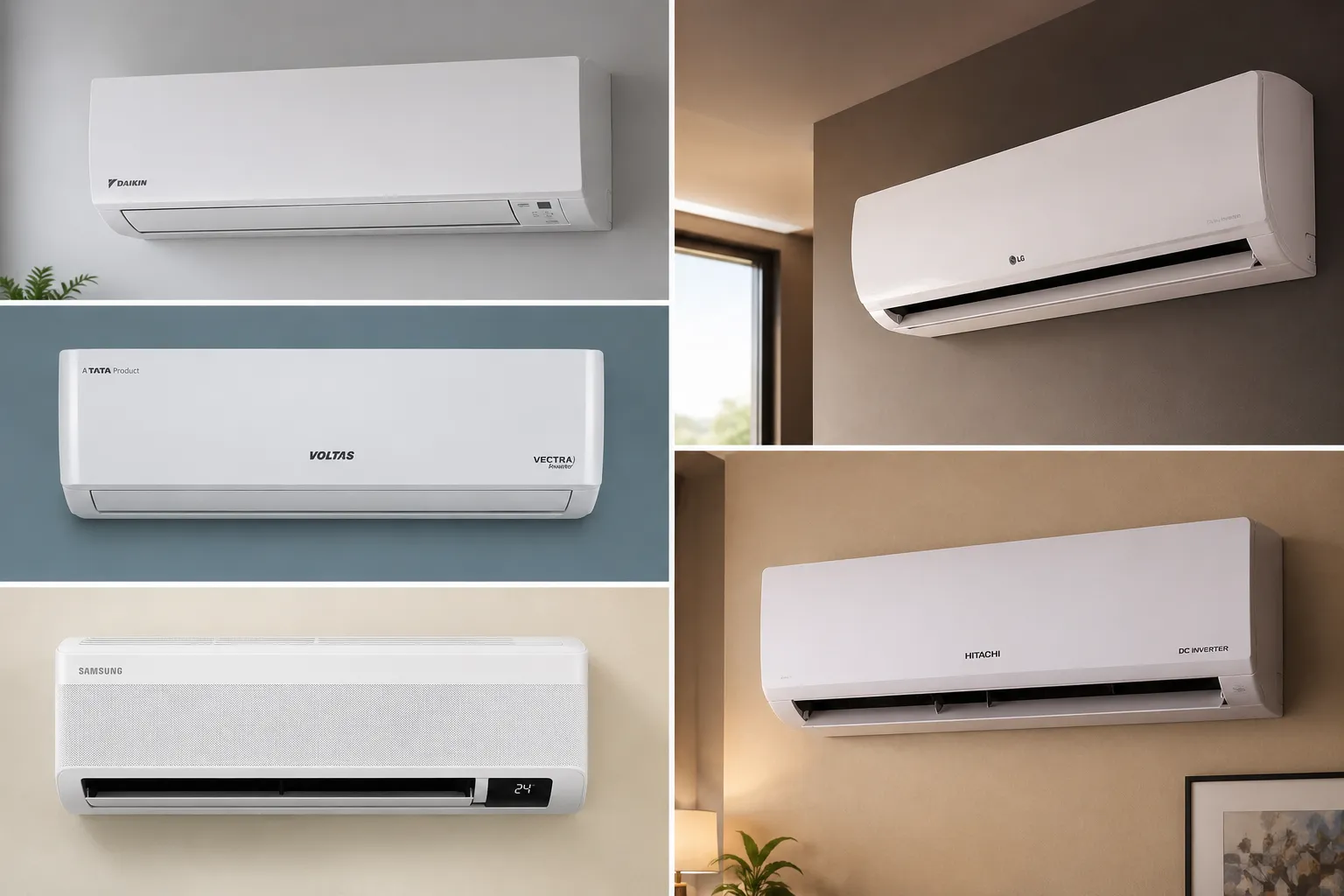
Best 5 New Inverter ACs in India (2026): Price & Feature Comparison
TL;DR: If you want the best 5 new inverter AC India shortlist for 2026, start with 1.5-ton 5-star split ACs for most medium bedrooms and living rooms. LG, Daikin, Panasonic, Blue Star and Voltas all have strong options, but the right pick depends on your room size, daily usage, local service network, installation quality and electricity tariff. Expect approximately ₹38,000–₹55,000 for good 1.5-ton inverter models before installation extras.
Last updated: July 2026
Key takeaways
- For most Indian bedrooms of around 120–170 sq ft, a 1.5-ton inverter split AC is the safest shortlist size; smaller rooms may be fine with 1 ton.
- A 5-star inverter AC costs more upfront, but it makes better sense if you use the AC for 6–10 hours daily during summer.
- Approximate 2026 street prices vary widely by city, sale period and installation offers; always compare final invoice cost, not just online product price.
- Copper condenser coils, a clear warranty policy, and good local service support matter more than fancy app features.
- Installation quality can make or break performance: wrong vacuuming, poor drain slope, excess pipe bending or bad outdoor placement can reduce cooling and increase failures.
- For bill estimates, use your local tariff. Many urban households pay roughly ₹6–₹10 per unit after slabs and taxes, but it differs by state and consumption level.
Table of contents
- How we shortlisted these inverter ACs for Indian homes
- Best 5 new inverter ACs in India: quick comparison
- 1. LG 1.5 Ton 5 Star AI DUAL Inverter Split AC
- 2. Daikin 1.5 Ton 5 Star Inverter Split AC
- 3. Panasonic 1.5 Ton 5 Star Wi-Fi Inverter Split AC
- 4. Blue Star 1.5 Ton 5 Star Inverter Split AC
- 5. Voltas 1.5 Ton 5 Star Inverter Split AC
- Which inverter AC is best for your room size?
- Electricity bill comparison: realistic India examples
- Installation and service checks before paying
- Practical next steps
How we shortlisted these inverter ACs for Indian homes
The Indian AC market changes every summer. Model names, exact ISEER values, refrigerant labels, star ratings and prices can change between online listings and local dealers. So this guide focuses on practical buyer value rather than one fixed model code that may disappear from stock.
For this best 5 new inverter AC India comparison, the shortlist is based on common buying priorities in 2026: inverter compressor, 1.5-ton capacity availability, 5-star BEE options, copper condenser preference, brand presence across Indian cities, service reach, and features that are useful in real homes.
A 1.5-ton AC is used as the main comparison point because it is the most commonly considered size for Indian bedrooms, study rooms and compact living rooms. If your room is much smaller or larger, use the tonnage section below before choosing.
Important note on prices: the prices mentioned here are approximate 2026 market ranges. They can change due to summer demand, festival sales, exchange offers, card discounts, city-wise dealer margins and installation packages. Treat these figures as planning estimates, not guaranteed selling prices.
Best 5 new inverter ACs in India: quick comparison
| Rank | Inverter AC option | Typical capacity to compare | Approx 2026 price range | Best for | Key caution |
|---|---|---|---|---|---|
| 1 | LG 1.5 Ton 5 Star AI DUAL Inverter Split AC | 1.5 ton | ₹45,000–₹55,000 | Balanced features, efficiency, wide service reach | Check exact model’s ISEER and warranty terms |
| 2 | Daikin 1.5 Ton 5 Star Inverter Split AC | 1.5 ton | ₹43,000–₹53,000 | Strong cooling focus, simple operation | Some models may skip Wi-Fi or extra smart features |
| 3 | Panasonic 1.5 Ton 5 Star Wi-Fi Inverter Split AC | 1.5 ton | ₹42,000–₹52,000 | Smart control, app users, connected homes | Confirm local service quality in your area |
| 4 | Blue Star 1.5 Ton 5 Star Inverter Split AC | 1.5 ton | ₹41,000–₹51,000 | Hot cities, durable cooling preference | Installation quality is very important |
| 5 | Voltas 1.5 Ton 5 Star Inverter Split AC | 1.5 ton | ₹38,000–₹48,000 | Value buyers wanting familiar Indian brand | Compare noise level and after-sales reviews locally |
These are not the only good ACs in India. Hitachi, Carrier, Lloyd, Samsung, Godrej, Whirlpool and Haier also sell competitive models. But if you want a clean shortlist of five widely discussed inverter AC choices, the options above are a practical starting point.
1. LG 1.5 Ton 5 Star AI DUAL Inverter Split AC
LG’s 1.5-ton 5-star dual inverter split AC models are popular because they offer a balanced package: energy efficiency, copper condenser, decent feature set, modern design and a broad service network in many Indian cities.
The “dual inverter” branding generally refers to LG’s compressor technology designed to vary speed efficiently instead of switching fully on and off like older fixed-speed ACs. In daily use, this helps maintain more stable room temperature and can reduce electricity consumption when the AC runs for long hours.
Typical useful features you may find depending on the exact 2026 model include convertible cooling modes, HD filter or anti-virus filter branding, ocean black protection or similar coating, stabilizer-free operation within a specified voltage range, auto clean and sleep mode. Some versions may include Wi-Fi; others may not.
Approximate price range: ₹45,000–₹55,000 for 1.5-ton 5-star variants, before extra installation costs. During major online sales, effective prices may be lower with bank offers, but always check what is included.
Choose this if you want one of the safest all-rounders and you have LG service support nearby. Avoid choosing only by the “AI” label. Instead, compare the BEE star label, ISEER value, annual energy consumption figure, warranty on compressor and PCB, and installation charges.
Best suited for: bedrooms and small living rooms around 120–170 sq ft, especially where the AC may run 6 or more hours daily in summer.
2. Daikin 1.5 Ton 5 Star Inverter Split AC
Daikin has a strong reputation in air conditioning, especially among buyers who prefer cooling performance and relatively straightforward controls over extra digital features. Many Daikin inverter split ACs focus on core AC performance: compressor reliability, airflow, quiet operation and efficient cooling.
In 2026, a Daikin 1.5-ton 5-star inverter model is a strong option for users who do not necessarily need Wi-Fi, voice assistant support or a crowded remote. Some models may offer PM filters, Coanda airflow-style distribution, self-diagnosis, stabilizer-free operation across a defined voltage range and strong compressor warranty terms.
Approximate price range: ₹43,000–₹53,000 for many 1.5-ton 5-star inverter models. Premium variants or dealer-specific models may cost more.
Daikin is a good pick if you want dependable cooling and are ready to pay slightly more for brand confidence. However, check installation availability before buying online. In some locations, the difference between a good and average installation team can be large. Ask whether vacuum pump installation is done properly, whether the provided copper pipe length is enough, and what additional charges apply.
Best suited for: people who value cooling quality, stable operation and simple long-term use over app-based control.
3. Panasonic 1.5 Ton 5 Star Wi-Fi Inverter Split AC
Panasonic’s 1.5-ton 5-star Wi-Fi inverter ACs are popular among buyers who like smart controls. Many models support app-based operation, scheduling, temperature adjustment, and sometimes integration with voice assistants. For working couples, renters, or families who want to switch on the AC before reaching home, these features can be useful.
The practical value of smart AC features depends on your routine. If you use timers and schedules properly, Wi-Fi control can prevent unnecessary runtime. For example, you may schedule the AC to turn off after midnight or switch to a milder temperature setting after the room cools down. But smart features do not automatically guarantee lower electricity bills; your temperature setting, room sealing and usage hours matter more.
Approximate price range: ₹42,000–₹52,000 for 1.5-ton 5-star Wi-Fi inverter models. Some 3-star Wi-Fi versions can be cheaper, but compare the BEE label if your summer usage is high.
Check whether the exact model has a copper condenser, what type of air filter is included, whether the app is supported for your phone, and whether service technicians in your area are comfortable with smart PCB or connectivity issues.
Best suited for: buyers who want remote control, scheduling and a connected-home experience without ignoring energy efficiency.
4. Blue Star 1.5 Ton 5 Star Inverter Split AC
Blue Star is a familiar name in Indian cooling, with a long presence in both residential and commercial air conditioning. Its 1.5-ton 5-star inverter split ACs are worth considering in hot cities and homes where strong cooling is a priority.
Depending on the model, Blue Star may offer features such as convertible cooling, turbo cool, anti-corrosive blue fin protection, self-clean, comfort sleep and stabilizer-free operation within the stated range. Many buyers also look at Blue Star for its heavy-duty image, although the exact experience depends on the model and local service.
Approximate price range: ₹41,000–₹51,000 for 1.5-ton 5-star inverter variants. You may see lower prices for 3-star models or previous-year stock.
This brand can be a good fit if your room gets harsh afternoon sun or if you live in a very hot region such as parts of Rajasthan, Gujarat, Delhi NCR, Telangana, Andhra Pradesh, Maharashtra or central India. But do not oversize blindly. A 2-ton AC in a small room may cool quickly but can short-cycle, feel clammy and waste money.
Best suited for: users who want strong cooling performance and have reliable Blue Star service support nearby.
5. Voltas 1.5 Ton 5 Star Inverter Split AC
Voltas remains one of India’s most recognised AC brands, and its 1.5-ton 5-star inverter split ACs often appeal to value-focused buyers. The pricing is usually competitive compared with some premium international brands, while service reach is generally broad in many regions.
Common features in 2026 Voltas inverter AC models may include adjustable or convertible cooling modes, copper condenser, anti-dust filter, sleep mode, turbo mode and stabilizer-free operation within a specified voltage band. Some models may offer smart-ready or Wi-Fi features, but check the exact listing carefully.
Approximate price range: ₹38,000–₹48,000 for many 1.5-ton 5-star inverter options, though premium variants can cost more.
Voltas can make sense if you want a familiar brand at a more controlled budget. Before purchasing, compare indoor unit noise, warranty on PCB and compressor, and installation terms. If buying from a local dealer, ask whether the displayed price includes standard installation, copper pipe, drain pipe, outdoor stand and GST. If buying online, read the installation terms line by line.
Best suited for: budget-conscious households that still want inverter efficiency and a 5-star option for regular summer use.
Which inverter AC is best for your room size?
Choosing the right tonnage is more important than choosing the most advertised model. In India, room heat load depends on square footage, ceiling height, floor level, sunlight, number of people, appliances and insulation.
| Room condition | Suggested AC capacity | Notes |
|---|---|---|
| Up to 100 sq ft, low sunlight | 0.8–1 ton | Good for small bedrooms or study rooms |
| 100–130 sq ft, normal Indian bedroom | 1 ton or 1.2 ton | Choose 1.5 ton only if heat load is high |
| 130–170 sq ft, medium bedroom | 1.5 ton | Most common and practical choice |
| 170–220 sq ft, living room or sunny room | 1.5 ton high-capacity or 2 ton | Consider sun exposure and ceiling height |
| Top floor, west-facing wall, poor insulation | Add margin | A technician heat-load check helps |
If your room is on the top floor under a concrete roof, gets direct afternoon sun, or has large glass windows, a normal size chart may understate your cooling requirement. Use curtains, reflective film, door sealing and roof insulation where possible. These small changes can reduce AC load without buying an oversized unit.
Electricity bill comparison: realistic India examples
The biggest long-term cost of an AC is not the purchase price. It is electricity. A 5-star inverter AC can cost more upfront, but the running cost benefit becomes meaningful when usage is high.
Let’s use a simple example. Suppose your 1.5-ton inverter AC averages around 0.8–1.1 kWh per hour after the room stabilises. Actual consumption can be higher during initial cooling or extreme heat and lower at night or at higher temperature settings. If your tariff is ₹8 per unit and you run the AC for 8 hours a day:
- Lower estimate: 0.8 kWh × 8 hours × ₹8 = ₹51.20 per day
- Higher estimate: 1.1 kWh × 8 hours × ₹8 = ₹70.40 per day
- Approx monthly range for 30 days: ₹1,536–₹2,112
Now compare that with a less efficient or badly installed unit averaging 1.3 kWh per hour:
- 1.3 kWh × 8 hours × ₹8 = ₹83.20 per day
- Approx monthly cost: ₹2,496
This does not mean every 5-star AC will save the same amount. Real savings depend on weather, temperature setting, insulation, filter condition, outdoor unit airflow and your tariff slab. But it shows why efficiency matters if your AC runs every night.
A practical buying rule: if you use the AC only 1–2 hours occasionally, a cheaper 3-star inverter may be enough. If you use it 6–10 hours daily for several months, shortlist 5-star inverter models and compare ISEER values seriously.
Features that matter versus marketing noise
Many AC listings contain long feature names, but only a few specifications affect daily comfort and cost.
Prioritise these:
- BEE star rating and ISEER: Higher ISEER generally means better seasonal efficiency.
- Annual energy consumption on BEE label: Useful for comparing two models of the same capacity.
- Copper condenser: Preferred by many buyers for repairability and heat transfer.
- Compressor and PCB warranty: Inverter AC repairs can be expensive outside warranty.
- Noise level: Important for bedrooms, children’s rooms and elderly users.
- Airflow and swing: Helps distribute cooling evenly in long rooms.
- Voltage operating range: Useful in areas with voltage fluctuation, but not a replacement for safe wiring.
- Local service quality: A good service team is worth more than one extra filter name.
Treat these as secondary:
- Too many convertible modes if you never use them.
- Health filter claims without clear replacement cost.
- App control if your Wi-Fi is unreliable or you prefer remote-only use.
- Extremely low price listings where installation extras are unclear.
Installation and service checks before paying
A good inverter AC can perform badly if installed poorly. Before final payment, ask the seller or installer these questions:
| Installation item | What to confirm | Why it matters |
|---|---|---|
| Copper pipe length | Included length and extra per-metre charge | Avoid surprise billing |
| Vacuum pump use | Whether proper vacuuming is done | Protects cooling performance and compressor life |
| Outdoor unit placement | Shade, airflow and service access | Prevents overheating and difficult repairs |
| Drain pipe slope | Water should flow freely | Avoids indoor leakage |
| Wall core cutting | Who does it and cost | Often charged separately |
| Outdoor stand | Included or extra | Needed in many flats |
| Electrical point | Proper MCB/plug/wiring | Safety and warranty support |
| Stabilizer need | Based on voltage in your area | Prevents damage in unstable supply areas |
Also keep the invoice, warranty card, installation report and service contact number safely. If the AC has app registration, complete it soon after installation. Many warranty claims become easier when the product is properly registered.
Which one should you buy?
Here is a simple decision guide:
- Pick LG if you want a balanced premium all-rounder with broad service availability.
- Pick Daikin if your top priority is strong cooling and simple operation.
- Pick Panasonic if Wi-Fi control and scheduling matter to you.
- Pick Blue Star if you live in a very hot region and want a cooling-focused brand.
- Pick Voltas if you want value pricing with wide brand familiarity in India.
For most homes, the best choice will be the model that matches the room size, has a strong BEE rating, is installed properly and has service support within your city. A slightly less advertised AC with better local service can be a wiser purchase than a famous model with poor installation support.
Practical next steps
- Measure your room length, width and ceiling height.
- Note heat factors: top floor, west-facing wall, large windows, direct sun and number of people.
- Shortlist the right capacity first: 1 ton, 1.5 ton or 2 ton.
- Compare 3-star and 5-star inverter models using the BEE label, not just marketing claims.
- Ask for the final installed cost including stand, extra copper pipe, drain pipe, core cutting and GST.
- Check brand service reviews in your city or neighbourhood, not only national ratings.
- After installation, run the AC at 24–26°C, use ceiling fan support at low speed if comfortable, and clean filters regularly.
Conclusion
The best 5 new inverter AC India shortlist for 2026 includes strong options from LG, Daikin, Panasonic, Blue Star and Voltas. But the smartest purchase is not always the most expensive or the most feature-heavy model. Choose the right tonnage, verify the BEE label, estimate your electricity cost, and confirm installation quality before paying.
If your AC will run for long hours in peak summer, a 5-star inverter model is usually worth serious consideration. If your usage is light, focus on correct sizing and reliable service instead of chasing the highest specification. Comfort per rupee over five summers is the real target.
About the author
AC Kharcha Team — research-focused AC guides for India. We study air conditioner specifications, electricity cost patterns, installation practices and common buyer problems to help Indian households choose and use ACs more confidently.
Frequently asked questions
Which is the best inverter AC in India in 2026?
There is no single best model for every home. For a 1.5-ton 5-star inverter AC, LG, Daikin, Panasonic, Blue Star and Voltas all have strong options. Choose based on room size, BEE label, local service support, warranty terms and final installed price.
Is a 5-star inverter AC worth buying in India?
Yes, if you use the AC for long hours, especially 6 or more hours daily during summer. A 5-star inverter AC usually costs more upfront but can reduce electricity consumption over time compared with a lower-efficiency model. For occasional use, a good 3-star inverter AC may be enough.
What is the approximate price of a 1.5-ton 5-star inverter AC in 2026?
In 2026, many good 1.5-ton 5-star inverter split ACs in India cost approximately ₹38,000–₹55,000 before extra installation charges. Prices vary by city, sale season, model year, dealer offer and included accessories.
How much electricity does a 1.5-ton inverter AC use?
A 1.5-ton inverter AC may average roughly 0.8–1.3 units per hour depending on temperature setting, room heat load, star rating, outdoor temperature and installation quality. Actual consumption can be higher during initial cooling and lower once the room stabilises.
Is 1.5 ton AC enough for a bedroom?
For many Indian bedrooms around 130–170 sq ft, a 1.5-ton AC is suitable. Smaller rooms may need only 1 ton, while top-floor or west-facing rooms with strong sunlight may need extra cooling capacity or better insulation.
Should I buy an AC online or from a local dealer?
Both can be fine. Online buying may offer discounts, while local dealers may give clearer installation support and faster service coordination. Compare the final installed cost, warranty, return terms, installation scope and service availability before deciding.
Do inverter ACs need a stabilizer?
Many inverter ACs advertise stabilizer-free operation within a specified voltage range, but this does not cover every situation. If your area has frequent voltage fluctuations, ask the brand technician or a qualified electrician whether a stabilizer or proper electrical protection is needed.
Last updated: 06 Sep, 2026 · Verified by editorial team
About the author
AC Kharcha Editorial Team
AC research & buying guides · India · We research air conditioners, electricity costs, and home cooling practices across Indian climates, then publish practical guides so households can buy and run ACs more confidently.
View all articles →Share this guide
Was this article helpful?
Related posts
 New AC models in India (2026)
Optimist 1.4 Ton 5-Star AC 2026: Can an Indian Startup Beat 1.5T Brands?
Optimist’s 1.4 ton 5-star AC 2026 is a bold first launch: ₹39,990, claimed ISEER 6.05, and a size that could suit Indian bedrooms.
 New AC models in India (2026)
Oakter Studio AC 5000 2026: 0.5 Ton AC for Small Rooms
A practical 2026 guide to Oakter Studio AC 5000-style 0.5 ton cooling for small Indian rooms, including room fit, electricity cost, installation checks and alternatives.
 New AC models in India (2026)
AKAI Nilgiree AC 2026: 55°C Cooling Claim?
AKAI Nilgiree AC 2026: 55°C cooling claim explained with India-focused buying advice, bill estimates, installation checks and practical usage tips.