
LG Essential Series AC 2026: BEE label buying guide | AC Kharcha
LG Essential Series AC 2026: BEE Label — a practical India-focused guide to BEE stars, ISEER, electricity costs, tonnage, installation, and buying checks.
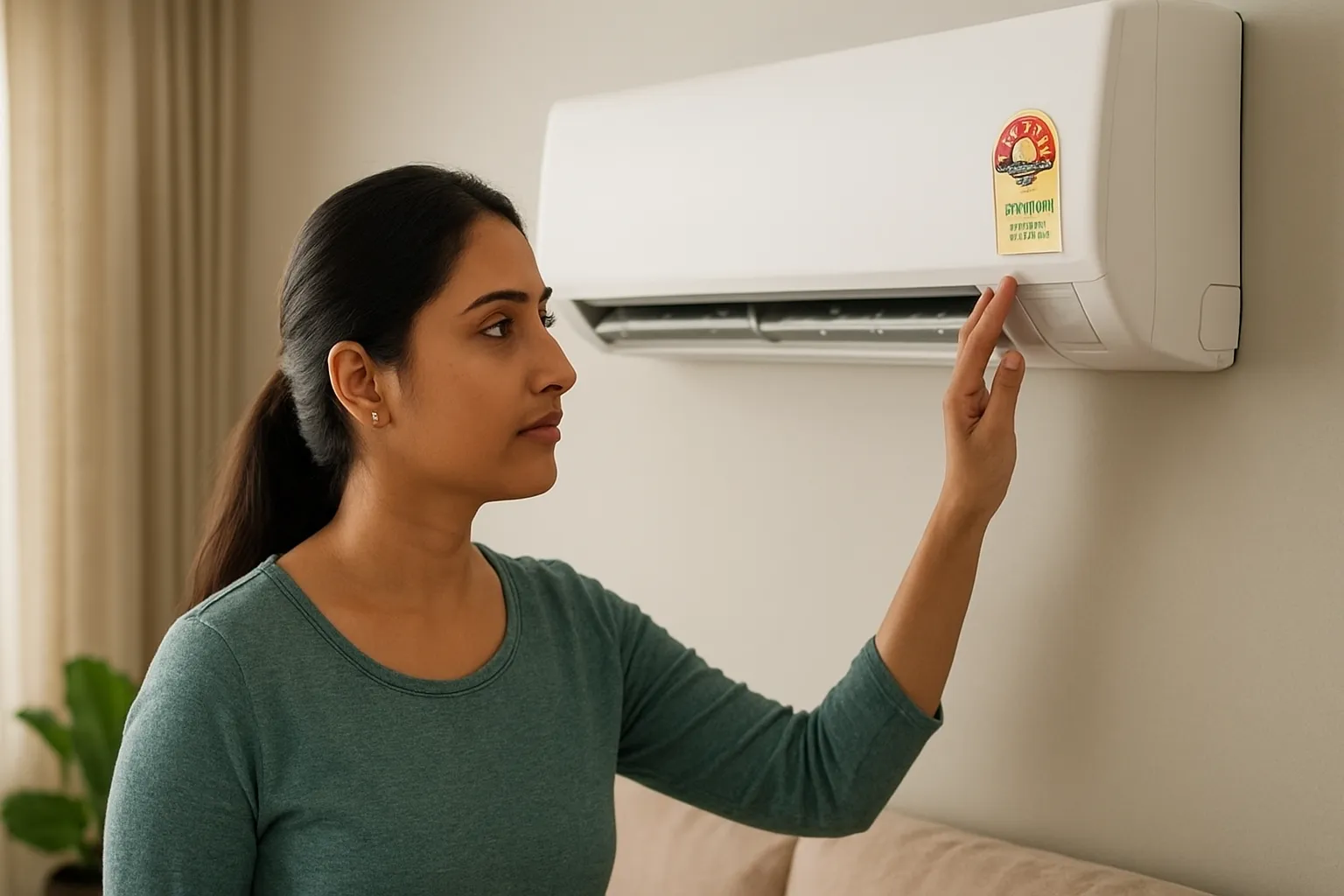
LG Essential Series AC 2026: how to read the BEE label
TL;DR: The BEE label on an LG Essential Series AC tells you the star rating, ISEER value, cooling capacity, annual electricity consumption estimate, and model validity period. For Indian homes in 2026, do not buy only by star count; compare ISEER, correct tonnage, your daily usage hours, local electricity tariff, installation quality, and service support. A 5-star inverter model can save more in a bedroom used every night, while a 3-star model may be enough for short daily use.
Last updated: July 2026
Key takeaways
- The BEE label is the quickest way to compare LG Essential Series AC efficiency, but the ISEER number and annual units matter more than the star graphic alone.
- For a 1.5-ton split AC, a higher star model usually costs more upfront but can recover the difference if you run it 6–10 hours daily during hot months.
- Check the label validity year because old-stock ACs may carry older BEE ratings that are not directly comparable with 2026-labelled models.
- Match tonnage to the room: a 1-ton AC for many compact bedrooms, 1.5-ton for typical medium rooms, and 2-ton only for larger or high-heat spaces.
- The annual electricity consumption printed on the BEE label is a standard test estimate, not your exact bill; your city, set temperature, room sealing, and usage pattern will change the result.
- Installation can make or break efficiency: poor vacuuming, bad drain slope, crushed copper pipes, or wrong outdoor placement can waste power and reduce cooling.
- This lg essential series ac bee label kenar guide is best used before purchase, while comparing retail listings, shop-floor stickers, and installation quotes.
Table of contents
- What the BEE label means on LG Essential Series ACs
- How to read the 2026 BEE label step by step
- LG Essential Series AC models: what to compare before buying
- BEE star rating vs ISEER: which number should you trust?
- Electricity bill examples for Indian homes
- Choosing the right tonnage with the BEE label
- Installation and service checks that affect BEE performance
- Common mistakes while reading AC BEE labels
- Practical next steps
- Conclusion
What the BEE label means on LG Essential Series ACs
The BEE label is the official energy-efficiency sticker issued under India’s Bureau of Energy Efficiency programme. On LG Essential Series ACs, it helps you compare running cost before you get carried away by offers, design, Wi-Fi features, or cashback banners.
For a buyer, the label answers five important questions:
- How efficient is this AC compared with similar capacity ACs?
- How many units might it consume under standard test conditions?
- What is the cooling capacity?
- What is the ISEER value?
- Is the rating valid for the current BEE schedule?
The LG Essential Series is generally positioned for buyers who want reliable split AC cooling without paying for every premium feature. Depending on the exact listing in 2026, you may find LG Essential models in common Indian capacities such as 1 ton, 1.5 ton, and sometimes 2 ton, with inverter compressor options and different BEE star ratings. Model availability changes by city, season, and retailer, so always verify the exact model code printed on the indoor unit box, outdoor unit box, invoice, and BEE label.
A useful point: the BEE label is not a decoration. If two ACs have similar tonnage and price, the label can show which one is likely to cost less to run. However, it is still only one part of the decision. A poorly installed 5-star AC may perform worse than a correctly installed 3-star AC in a well-sealed room.
How to read the 2026 BEE label step by step
When you are standing in a store or checking a product page, zoom in on the BEE label photo if available. If the listing does not show it clearly, ask the seller for the model number and the latest label details.
Here is what to check on the label:
| BEE label field | What it means | What Indian buyers should do |
|---|---|---|
| Star rating | 1-star to 5-star efficiency band | Use it for quick comparison, but do not stop here |
| ISEER | Indian Seasonal Energy Efficiency Ratio | Prefer the higher ISEER when tonnage and type are similar |
| Annual electricity consumption | Estimated yearly units under standard usage | Multiply by your tariff for a rough running-cost estimate |
| Cooling capacity | Actual rated cooling output in watts | Confirm it matches your room heat load, not just “1.5 ton” marketing |
| Compressor type | Usually inverter or fixed-speed | Inverter is generally better for long daily runtime |
| Label period | Validity under a BEE schedule | Avoid comparing old and new labels blindly |
| Model number | Exact AC identity | Match it with invoice and retailer listing |
The label period matters because BEE periodically tightens rating standards. A 5-star rating from an older schedule may not mean the same as a 5-star rating under a later schedule. In 2026, if you are buying new stock, check whether the model is being sold with a current or recently valid BEE label. Old inventory may still be legally sold in some cases, but you should understand what you are buying.
Also note that online marketplaces sometimes group multiple variants under one product page. One colour, one tonnage, or one star variant may have different label values from another. For example, do not assume a 1-ton 5-star variant and a 1.5-ton 3-star variant have the same annual consumption just because both are from the Essential Series.
LG Essential Series AC models: what to compare before buying
LG’s AC line-up in India can include multiple series and retailer-specific variants. For the Essential Series, buyers usually compare it with LG Dual Inverter models, convertible cooling models, and other mainstream split ACs from brands such as Voltas, Daikin, Blue Star, Panasonic, Lloyd, Hitachi, and Samsung.
Before deciding, compare these practical specifications:
- Capacity: 1 ton, 1.5 ton, or 2 ton depending on room size and heat load.
- BEE rating: 3-star and 5-star variants are the most commonly compared for middle-class Indian homes.
- ISEER: Higher is better when comparing similar capacity inverter ACs.
- Annual units on label: Useful for a rupee estimate.
- Noise level: Important for bedrooms, study rooms, and work-from-home spaces.
- Condenser material: Copper condenser is preferred by many buyers for repairability and heat transfer.
- Warranty: Check comprehensive warranty, compressor warranty, PCB warranty, and exclusions.
- Convertible modes: Some LG ACs offer capacity control modes. These can help when heat load is low, but they are not a substitute for correct tonnage.
- Stabilizer-free operating range: Helpful in areas with voltage fluctuation, but confirm whether your local electrician still recommends a stabilizer.
Approximate 2026 street prices can vary widely by city and sale season. As a broad India-market expectation, a 1.5-ton LG split inverter AC may be seen around the mid-₹30,000s to ₹50,000+ depending on star rating, features, installation offers, and card discounts. Treat this only as a rough range. Summer peak pricing in April–June can be higher, while festive sales may reduce effective price.
BEE star rating vs ISEER: which number should you trust?
The star rating is easy to understand, but the ISEER value is the more precise comparison number. ISEER stands for Indian Seasonal Energy Efficiency Ratio. It reflects how efficiently the AC performs across different outdoor temperatures and part-load conditions that are more relevant to India than one fixed lab condition.
For example, if two 1.5-ton inverter ACs are both 3-star, the one with the higher ISEER is generally more efficient. Similarly, a 5-star model should normally have a better ISEER than a 3-star model in the same capacity class, but the gap should be checked on the label rather than assumed.
Here is a simple way to think about it:
| Your usage pattern | What matters most | Suggested approach |
|---|---|---|
| 2–3 hours daily, mainly afternoon | Purchase price and adequate cooling | A good 3-star inverter may be practical |
| 6–8 hours nightly in summer | ISEER and annual units | Strongly compare 5-star options |
| 10+ hours daily, work-from-home room | Efficiency, noise, service support | Higher ISEER can pay back faster |
| Guest room or occasional use | Budget and warranty | Avoid overspending on unused efficiency |
| Top-floor room with west sun | Capacity and heat load | Do not downsize only to save money |
Do not confuse ISEER with instant power draw. Inverter ACs change compressor speed based on load. At startup or in extreme heat, consumption can be higher; after the room stabilises, it can reduce. That is why your actual monthly bill depends heavily on runtime, set temperature, insulation, and outdoor temperature.
Electricity bill examples for Indian homes
The BEE label’s annual electricity consumption is calculated using standard assumptions. Your bill will not match it perfectly, but it is still useful for comparison.
Let us use a simple example. Suppose you are comparing two approximate 1.5-ton LG Essential Series inverter AC variants:
- Option A: 3-star, label estimate around 950–1,050 units per year
- Option B: 5-star, label estimate around 750–850 units per year
These numbers are illustrative ranges only. Always check the exact label on the model you are buying.
If your electricity tariff is ₹8 per unit, the rough annual running-cost difference could be:
- Option A: 1,000 units × ₹8 = ₹8,000 per year
- Option B: 800 units × ₹8 = ₹6,400 per year
- Approximate saving: ₹1,600 per year
If your city tariff including slabs, fixed charges, and taxes effectively comes closer to ₹10 per unit, the same 200-unit difference becomes around ₹2,000 per year. If you run the AC heavily, the real-world gap may be higher; if you use it rarely, payback will be slower.
Now compare this with upfront price. If the 5-star model costs ₹5,000 more than the 3-star model, and your realistic saving is ₹1,500–₹2,500 per year, it may recover the difference in about 2–4 summers. But if the price gap is ₹10,000 and you use the AC only occasionally, a 3-star model may be the more sensible choice.
This is the most practical way to use the lg essential series ac bee label kenar guide: do not ask only “Which star is best?” Ask “Which model gives better comfort per rupee for my actual usage?”
Choosing the right tonnage with the BEE label
Many buyers make the mistake of treating BEE stars as more important than tonnage. Both matter, but wrong tonnage can ruin comfort and efficiency.
As a broad Indian home estimate:
| Room type | Approximate room size | Common starting point | Adjust upward if… |
|---|---|---|---|
| Small bedroom | Up to 100–120 sq ft | 1 ton | Top floor, poor insulation, direct west sun |
| Medium bedroom | 120–170 sq ft | 1.5 ton | More occupants, large windows, hot city |
| Large bedroom/living room | 180–240 sq ft | 1.5–2 ton | Open layout, high ceiling, kitchen heat nearby |
| Very hot top-floor room | Any size | Heat-load check needed | Roof heating is severe or room is poorly sealed |
A smaller AC may look efficient on the label but run continuously and still fail to cool the room. An oversized AC can cool quickly but may short-cycle, reduce humidity removal, and feel uncomfortable. Inverter ACs handle part-load better than fixed-speed units, but correct sizing is still important.
Also check the rated cooling capacity in watts on the BEE label. Sometimes two ACs marketed as the same tonnage can have slightly different actual cooling capacities. For a difficult room in cities like Delhi, Jaipur, Nagpur, Ahmedabad, Hyderabad, or parts of inland Karnataka and Telangana, those differences can matter.
Installation and service checks that affect BEE performance
The BEE label assumes proper installation. In real Indian homes, installation quality often decides whether the AC performs close to its rating.
Before installation, confirm these points:
- Outdoor unit location: It needs airflow. Avoid closed balconies, cramped shafts, and spots blowing hot air into another outdoor unit.
- Copper pipe length: Keep within manufacturer limits. Very long runs can affect performance and may need additional refrigerant as per company procedure.
- Vacuuming: Proper vacuuming of the refrigerant line is important for long-term cooling and compressor health.
- Drain slope: Poor drain routing can cause water leakage inside the room.
- Wall strength: The indoor and outdoor brackets must be fixed securely.
- Electrical supply: Use correct MCB, wiring size, earthing, and plug arrangement as advised by the brand technician or qualified electrician.
- Stabilizer decision: If voltage fluctuation is common in your area, ask a qualified electrician. “Stabilizer-free operation” does not mean every home is safe without protection.
- Invoice and warranty registration: Ensure the exact model number and serial number are recorded.
For LG Essential Series ACs, also ask what is included in the standard installation and what costs extra. Extra copper pipe, drain pipe, outdoor stand, core cutting, and electrical work can add to the final cost. In many Indian cities, the difference between the online “deal price” and the final installed cost can be several thousand rupees.
Common mistakes while reading AC BEE labels
A BEE label is helpful only if you read it correctly. Avoid these common mistakes:
- Comparing different tonnages directly: A 1-ton 5-star AC and a 1.5-ton 5-star AC will not consume the same power.
- Ignoring ISEER: Star rating is a band; ISEER gives a sharper comparison.
- Assuming annual units are your exact bill: Your usage may be very different from the test assumption.
- Buying old stock without checking label validity: Ask the seller when the model was manufactured and which BEE schedule applies.
- Trusting only marketplace titles: Product titles can be incomplete. Match model number, star rating, and capacity.
- Skipping local service checks: A good AC with weak local service can become expensive after warranty issues.
- Setting 18°C and expecting savings: Even a 5-star inverter AC will consume more if forced to maintain very low temperatures in extreme heat.
- Not cleaning filters: Dusty filters reduce airflow and increase runtime.
For most Indian families, a sensible setting of 24–26°C, ceiling fan at low or medium speed, closed curtains during peak sun, and clean filters can reduce waste without sacrificing comfort.
Maintenance tips to keep efficiency close to the label
The BEE label shows expected efficiency when the AC is in good condition. Over time, dust, blocked coils, weak airflow, and poor refrigerant condition can increase consumption.
Follow a simple maintenance routine:
- Clean indoor filters every 2–4 weeks during heavy use, especially in dusty cities.
- Keep curtains or blinds closed during harsh afternoon sun.
- Do not block the indoor unit return air path with wardrobes or curtains.
- Keep at least reasonable clearance around the outdoor unit.
- Wash or service coils professionally before peak summer if the AC was unused for months.
- Watch for warning signs: weak cooling, ice formation, unusual noise, water leakage, frequent tripping, or sudden bill increase.
- Use dry mode only when humidity is the main issue; it is not always the best cooling mode for extreme heat.
- Do not attempt gas charging or electrical repairs yourself.
If the AC is under warranty, use authorised service channels where required. Unauthorised repairs can affect warranty claims, especially for compressor or PCB issues.
Practical next steps
- Shortlist the exact LG Essential Series model code you are considering, not just “LG 1.5 ton AC”.
- Check the BEE label photo for star rating, ISEER, annual units, cooling capacity, and label validity.
- Estimate your bill: annual units or expected monthly units × your approximate tariff, such as ₹7–₹10 per unit depending on your state and slab.
- Decide 3-star vs 5-star by usage: choose higher efficiency for long nightly or daily use; consider 3-star if usage is low and price gap is large.
- Confirm tonnage with room conditions: size, floor, sun direction, ceiling height, number of people, and window area.
- Ask for total installed cost: include copper, stand, drain pipe, electrical work, GST, and any service charges.
- Verify service support in your PIN code before payment, especially outside metro areas.
- After installation, use it efficiently: set 24–26°C, clean filters, seal gaps, and schedule service before summer.
Conclusion
The BEE label on an LG Essential Series AC is one of the most useful tools for Indian buyers in 2026. It helps you compare star rating, ISEER, annual electricity consumption, and cooling capacity before you commit money. But the best purchase is not always the highest star model or the lowest price model. The right choice depends on your room size, daily runtime, local tariff, installation quality, and service access.
If you use your AC for many hours every night, a higher ISEER LG Essential Series model can be worth the extra upfront cost. If it is for a guest room or short evening use, a well-priced 3-star inverter may be enough. Read the label carefully, calculate running cost realistically, and insist on proper installation.
About the author
AC Kharcha Team — research-focused AC guides for India. We study air-conditioner specifications, BEE labels, electricity cost patterns, installation practices, and maintenance issues to help Indian households make clearer cooling decisions.
Frequently asked questions
What should I check first on the LG Essential Series AC BEE label?
Start with the star rating, ISEER value, annual electricity consumption, cooling capacity, model number, and label validity period. The ISEER and annual units are especially useful for estimating running cost.
Is a 5-star LG Essential Series AC always better than a 3-star model?
A 5-star model is usually more efficient, but it is not always the best value for every home. If you run the AC for many hours daily, the savings can justify the higher price. For occasional use, a 3-star inverter model may be more economical.
How do I estimate the electricity bill from the BEE label?
Multiply the annual electricity consumption printed on the label by your approximate electricity tariff. For example, 800 units at ₹8 per unit equals about ₹6,400 per year. Your actual bill can vary due to usage hours, temperature setting, insulation, and weather.
Can I compare the BEE label of a 1-ton AC with a 1.5-ton AC?
You can read both labels, but direct comparison is not fair because the cooling capacities are different. First choose the correct tonnage for your room, then compare star rating, ISEER, and annual units among similar-capacity models.
Does the BEE label guarantee low electricity bills?
No. The label gives a standard efficiency estimate. Actual bills depend on room size, outdoor temperature, daily runtime, set temperature, filter condition, installation quality, and local electricity tariff.
Should I worry about the BEE label validity period?
Yes. BEE rating standards change over time, so an older label may not be directly comparable with a current 2026 model. Check the label period and ask the seller if the unit is old stock.
What temperature setting is best for saving power on an LG Essential Series AC?
For most Indian homes, 24–26°C is a practical range for comfort and efficiency. Using a ceiling fan with the AC, closing curtains, sealing air gaps, and cleaning filters can also help reduce electricity waste.
Last updated: 06 Sep, 2026 · Verified by editorial team
About the author
AC Kharcha Editorial Team
AC research & buying guides · India · We research air conditioners, electricity costs, and home cooling practices across Indian climates, then publish practical guides so households can buy and run ACs more confidently.
View all articles →Share this guide
Was this article helpful?
Related posts
 How to buy an AC in India: tonnage, BEE stars, inverter
Blue Star Window AC 2026: Bharabarir Guide for Indian Homes
A practical 2026 guide to choosing, installing and running a Blue Star window AC in Indian homes, with cost examples, sizing tips and maintenance advice.
 How to buy an AC in India: tonnage, BEE stars, inverter
4-Star Inverter ACs 2026: Panasonic vs Samsung under ₹45k
4-Star Inverter ACs 2026: Panasonic vs Samsung under ₹45k — a practical India-focused guide to features, running costs, installation, and buying decisions.
 How to buy an AC in India: tonnage, BEE stars, inverter
BIS IS 1391:2023 AC Rule 2026: June Checklist
BIS IS 1391:2023 AC Rule 2026: June checklist — what Indian buyers should verify on room AC labels, star ratings, model details, installation, and running costs before purchase.