
1.5 ton AC buying guide: star rating and inverter (India) | AC Kharcha
A detailed India-focused 1.5 ton AC buying guide covering room size, BEE star ratings, inverter vs non-inverter choices, estimated costs, electricity bills, installation checks, and maintenance tips.
1.5 ton AC buying guide: star rating vs inverter
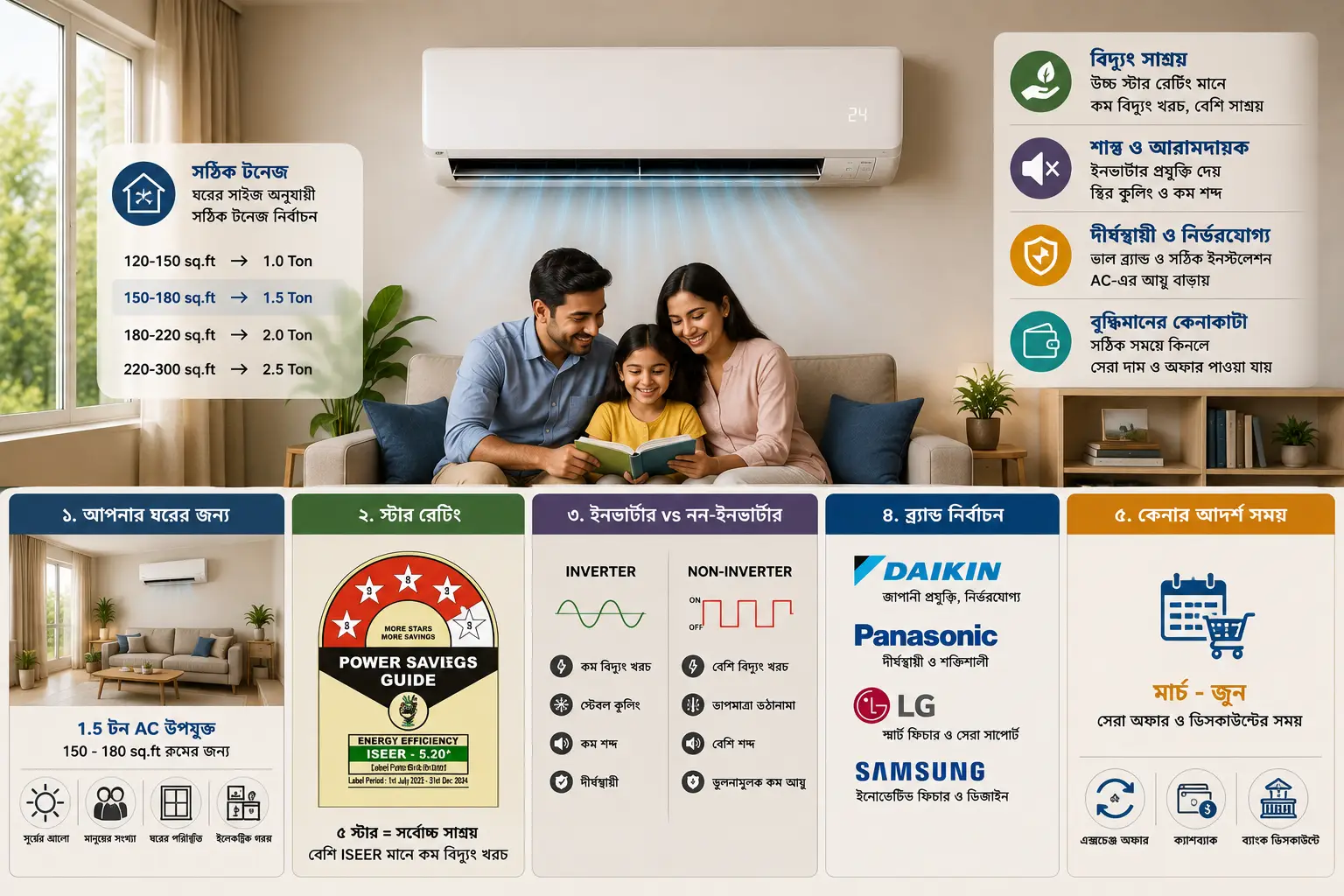
TL;DR: For most Indian bedrooms and medium living rooms, a 1.5 ton split AC is the safest capacity if the room is around 120–180 sq ft, reasonably sealed, and used for several hours daily. Choose an inverter AC if you run it at night or for long hours; consider non-inverter only for limited use and tight budgets. A BEE 3-star inverter AC usually balances purchase price and electricity cost, while a 5-star inverter makes sense for heavy summer use.
Last updated: July 2026
Key takeaways
- A 1.5 ton AC is suitable for many Indian rooms, but not every 1.5 ton model cools equally in top-floor, west-facing, or poorly insulated rooms.
- Inverter ACs cost more upfront but are better for long daily use because the compressor can slow down instead of switching fully on and off repeatedly.
- BEE star rating should be checked with the latest label year and ISEER value, not only the star sticker shown in an online image.
- For typical Indian usage, a 3-star inverter AC is often the value pick; a 5-star inverter becomes attractive when usage crosses 8–10 hours daily in summer.
- Installation quality matters as much as brand: vacuuming, correct copper pipe size, drain slope, outdoor placement, and proper electrical wiring affect cooling and durability.
- Approximate prices vary widely by city, season, sale offers, and included installation, so compare total installed cost, not only the AC box price.
Table of contents
- Is a 1.5 Ton AC Right for Your Room?
- Inverter vs Non-Inverter AC: What Actually Changes?
- BEE Star Rating and ISEER: How to Read the Label
- Electricity Bill Estimate for a 1.5 Ton AC
- Approximate 2026 Price Ranges in India
- Features Worth Paying For and Features You Can Ignore
- Installation Checklist Before You Pay
- Which 1.5 Ton AC Should You Buy for Different Homes?
- Maintenance Tips to Keep Cooling Strong
- Practical Next Steps
Is a 1.5 Ton AC Right for Your Room?
A 1.5 ton AC is one of the most common choices in India because it sits between small-bedroom 1 ton units and larger 2 ton units. But “1.5 ton” is not a universal answer. The right capacity depends on room size, sunlight, floor level, ceiling height, number of people, appliances, and how well the room is sealed.
As a broad starting point, a 1.5 ton AC usually suits:
| Room condition | 1.5 ton suitability | Notes |
|---|---|---|
| 120–150 sq ft bedroom | Very suitable | Often ideal if the room is not heavily sun-facing |
| 150–180 sq ft bedroom or study | Suitable | Works well with normal ceiling height and curtains |
| 180–200 sq ft living room | Conditional | May need 1.8 or 2 ton if crowded or sun-facing |
| Top-floor west-facing room | Conditional | Heat load is higher; check insulation and shade |
| Room with large glass windows | Conditional | Use curtains, films, or consider higher capacity |
| Open hall connected to kitchen | Often not enough | Cooling load rises due to open space and heat sources |
A common mistake is buying 1.5 ton only because a friend bought the same size. Two rooms with the same area can behave differently. A west-facing wall in Delhi, Ahmedabad, Jaipur, Nagpur, or Kolkata can store heat deep into the evening. A top-floor room under a concrete roof can need more cooling than a shaded room on a middle floor.
If your room is around 100–120 sq ft and shaded, a 1 ton or 1.2 ton inverter AC may be enough. If your room is closer to 200 sq ft with poor insulation, a 1.5 ton AC may run continuously and still struggle in May–June. In that case, buying a higher capacity AC can be more comfortable than forcing a smaller unit to work at full load all day.
Inverter vs Non-Inverter AC: What Actually Changes?
The biggest decision in a 1.5 ton AC buying guide is usually inverter vs non-inverter. The difference is in how the compressor operates.
A non-inverter AC has a fixed-speed compressor. It runs at full power until the room reaches the set temperature, then switches off. When the room warms again, it switches on again. This on-off pattern is simple and cheaper, but it can cause temperature swings and higher power draw during frequent starts.
An inverter AC has a variable-speed compressor. It can run fast at the beginning and then slow down to maintain temperature. This usually means better comfort, lower noise, and better efficiency during long use.
| Factor | Inverter 1.5 ton AC | Non-inverter 1.5 ton AC |
|---|---|---|
| Upfront price | Higher | Lower |
| Electricity use | Usually lower for long use | Often higher for long use |
| Comfort | More stable temperature | More temperature fluctuation |
| Noise | Usually quieter after initial cooling | Compressor cycles can be more noticeable |
| Repair cost | PCB and electronics can be costly | Simpler design may be cheaper to repair |
| Best for | Daily use, night use, long summers | Guest rooms, short use, low budget |
For Indian homes, inverter ACs make the most sense when the AC runs 5–10 hours per day during summer. This includes bedrooms used every night, work-from-home rooms, and family rooms used in the evening. Non-inverter ACs can still be considered if the AC is used occasionally, such as a guest room that runs only a few days a month.
One important point: an inverter AC does not always save huge electricity if you set it at 18°C, keep doors open, or use it in an oversized hot room. It saves best when the room can reach and maintain a reasonable temperature, typically 24–26°C.
BEE Star Rating and ISEER: How to Read the Label
BEE star rating is India’s official energy efficiency label for room air conditioners. For ACs, the important number is ISEER, which stands for Indian Seasonal Energy Efficiency Ratio. A higher ISEER generally means better seasonal efficiency.
When comparing 1.5 ton ACs, do not stop at “3-star” or “5-star”. Check:
- Label validity period
- Cooling capacity in watts
- Annual energy consumption shown on the label
- ISEER value
- Whether the rating is for the exact model number you are buying
Online listings sometimes show old images, similar model photos, or confusing variants. The model code matters. A brand may sell multiple 1.5 ton inverter ACs with different star ratings, different condenser materials, different filters, and different warranty terms.
A 5-star inverter AC usually costs more than a 3-star inverter AC. The extra cost may be worth it if your AC runs for long periods. If you use the AC only 2–3 hours daily for a few weeks, the payback may be slow. For many families, a 3-star inverter AC is the practical middle ground because it gives good efficiency without the highest purchase price.
For rental homes, consider how long you will stay. A 5-star model may be excellent, but if you shift frequently and installation/removal costs are high, a good 3-star inverter may be more practical.
Electricity Bill Estimate for a 1.5 Ton AC
Electricity bills depend on your tariff slab, AC model, room heat load, set temperature, and daily hours. The BEE label gives an annual energy consumption estimate under standard test assumptions, but your home conditions may differ.
Here is a simple way to estimate:
Monthly cost = units consumed per day × days used × electricity rate
Suppose your 1.5 ton inverter AC uses an average of 0.9–1.2 units per hour after initial cooling in normal conditions. If you run it 8 hours per night:
- Lower estimate: 0.9 × 8 × 30 = 216 units/month
- Higher estimate: 1.2 × 8 × 30 = 288 units/month
If your effective electricity rate is around ₹7–₹10 per unit, the monthly AC cost may be roughly:
- 216 units × ₹7 = ₹1,512
- 288 units × ₹10 = ₹2,880
This is only an approximation. In very hot rooms, high humidity, poor insulation, or 18–20°C settings, consumption can be higher. In milder weather, shaded rooms, and 25–26°C settings with a ceiling fan, consumption can be lower.
For comparison, a less efficient fixed-speed 1.5 ton AC may consume more during similar usage because it runs at full compressor speed whenever active. The real difference becomes visible over a full summer, especially in cities with high tariffs or heavy usage.
Approximate 2026 Price Ranges in India
Prices change during summer demand, festive sales, exchange offers, and stock clearance. Treat the following as approximate 2026 ranges, not fixed quotes.
| AC type | Approximate price range | Who should consider it |
|---|---|---|
| 1.5 ton non-inverter 3-star split AC | ₹30,000–₹38,000 | Occasional use, low upfront budget |
| 1.5 ton inverter 3-star split AC | ₹34,000–₹45,000 | Most regular bedroom users |
| 1.5 ton inverter 4-star split AC | ₹40,000–₹52,000 | Long use where pricing gap is reasonable |
| 1.5 ton inverter 5-star split AC | ₹43,000–₹60,000+ | Heavy users, high tariff areas, night-long use |
| Premium 1.5 ton inverter AC with advanced filtration or smart controls | ₹50,000–₹70,000+ | Buyers wanting comfort features beyond basic cooling |
Popular brands in India include LG, Daikin, Voltas, Blue Star, Panasonic, Carrier, Hitachi, Lloyd, Samsung, Godrej, Whirlpool, Haier, and IFB. Brand choice should not depend only on ads. Check service coverage in your city, spare parts availability, warranty terms, and installation quality.
Also confirm what the price includes. Some listings include standard installation; others charge separately. Extra copper pipe, outdoor stand, core cutting, drain pipe extension, electrical work, stabilizer, and removal of old unit may add to the final bill.
Features Worth Paying For and Features You Can Ignore
Modern AC listings are full of marketing terms. Some features are genuinely useful; others are optional.
Worth checking carefully:
- Copper condenser: Commonly preferred for durability and repairability in Indian conditions.
- Warranty on compressor and PCB: Inverter AC repairs can be expensive, so read warranty terms.
- Convertible cooling modes: Useful if you want to run at reduced capacity in mild weather, though savings depend on usage.
- Good air throw: Important for larger bedrooms or living rooms.
- Low noise rating: Helpful for light sleepers.
- Stabilizer-free operation range: Useful in voltage-fluctuation areas, but still ask a technician if your locality has serious voltage issues.
- Anti-corrosion coating: Helpful in coastal cities or industrial areas.
Optional or situation-based:
- Wi-Fi control: Convenient, but not necessary for cooling.
- PM filters and fancy filtration: Helpful for some users, but AC filters do not replace a dedicated air purifier.
- Voice assistant support: Nice to have, not essential.
- 4-way swing: Useful for wide rooms; less important in a small bedroom.
Be careful with claims like “instant bill saving” or “cools any room in seconds.” Cooling speed depends on room heat load, installation, outdoor temperature, and set temperature.
Installation Checklist Before You Pay
Many AC problems start with poor installation. A good 1.5 ton AC can perform badly if the indoor unit is placed incorrectly, the outdoor unit has poor airflow, or the refrigerant line is not handled properly.
Use this checklist before installation:
| Checkpoint | What to confirm | Why it matters |
|---|---|---|
| Indoor unit placement | High on wall, clear airflow, not blocked by wardrobe | Better air circulation |
| Outdoor unit placement | Open ventilation, service access, shade if possible | Heat rejection and compressor health |
| Copper pipe length | Correct size and minimum bends | Efficient refrigerant flow |
| Vacuuming | Technician uses vacuum pump before gas release | Removes moisture and air from line |
| Drain slope | Water flows out without backflow | Prevents leakage indoors |
| Electrical point | Proper MCB, wiring, earthing | Safety and warranty compliance |
| Wall strength | Outdoor bracket fixed securely | Reduces vibration and risk |
| Installation invoice | Written charges and scope | Avoids disputes later |
Ask the installer whether vacuuming will be done. Skipping vacuuming is a common shortcut and can harm performance over time. Also avoid placing the outdoor unit in a closed balcony without enough ventilation. The outdoor unit must throw hot air away; if it recirculates hot air, cooling drops and power use rises.
Which 1.5 Ton AC Should You Buy for Different Homes?
There is no single best 1.5 ton AC for everyone. Use your usage pattern.
For a regular bedroom used every night: Choose a 1.5 ton 3-star or 5-star inverter AC. If you run it 7–9 hours per night for several months, a 5-star model may recover some extra cost through lower bills over time.
For a rented flat: A 3-star inverter AC is often practical. Check installation and shifting costs. Choose a brand with service support in both your current city and likely future city if you move often.
For a top-floor hot room: Do not rely only on tonnage. Consider roof insulation, curtains, reflective paint, or a higher-capacity AC if the room is large. A 1.5 ton 5-star inverter may still struggle if the heat load is beyond its capacity.
For occasional use: A non-inverter AC can be considered if price is the main concern. But if the price gap with a 3-star inverter is small, the inverter option is usually better for comfort.
For coastal cities: Look for anti-corrosion protection and reliable service. Salt air can affect outdoor units faster.
For dusty areas: Easy-to-clean filters and regular service matter more than advanced app features.
Maintenance Tips to Keep Cooling Strong
After buying, your electricity bill depends heavily on how you use and maintain the AC. A dusty filter reduces airflow, makes the AC work harder, and can lead to poor cooling.
Follow these habits:
- Clean indoor filters every 2–4 weeks in summer, especially in dusty cities.
- Keep doors and windows closed while the AC runs.
- Use thick curtains on sun-facing windows.
- Set the temperature around 24–26°C for a good balance of comfort and cost.
- Use a ceiling fan at low or medium speed to distribute cool air.
- Do not block the indoor unit with curtains or furniture.
- Keep the outdoor unit free from leaves, plastic bags, and dust buildup.
- Book professional service before peak summer, not after the first heatwave.
- Watch for warning signs: ice formation, water leakage, unusual noise, weak airflow, or sudden bill increase.
Gas top-up should not be treated like routine petrol filling. If refrigerant is low, there may be a leak that needs checking. Repeated gas filling without leak repair wastes money.
Practical Next Steps
- Measure your room length and width, then note whether it is top-floor, west-facing, or has large windows.
- Decide your expected daily use: occasional, 3–5 hours, or 8+ hours.
- Shortlist 1.5 ton models by exact model number, BEE star rating, ISEER, and annual energy consumption.
- Compare total installed cost, including copper pipe, stand, drain pipe, electrical work, and stabilizer if needed.
- Choose inverter for regular use; consider non-inverter only if usage is low and upfront budget is strict.
- Verify local service availability before purchase, especially outside metro cities.
- After installation, run the AC at 24–26°C and clean filters regularly to control electricity cost.
Conclusion
A good 1.5 ton AC purchase is not only about star rating or brand name. It is a balance of room size, heat load, daily usage, electricity tariff, installation quality, and service support. For most Indian homes in 2026, a 1.5 ton 3-star inverter split AC is the practical value choice, while a 5-star inverter is better for heavy users who run the AC through long summer nights. Non-inverter ACs still have a place for limited use, but the long-term comfort and efficiency advantage usually favours inverter models.
Before buying, check the exact BEE label, estimate your running cost, and confirm installation details in writing. The best AC is the one that cools your actual room efficiently and can be serviced easily in your city.
About the author
AC Kharcha Team — research-focused AC guides for India. We study AC specifications, electricity costs, installation practices, and common home cooling problems to help Indian households make practical buying and usage decisions.
Frequently asked questions
Is a 1.5 ton AC enough for a 12x12 room in India?
Yes, a 12x12 room is about 144 sq ft, so a 1.5 ton AC is usually suitable if the room is reasonably sealed. If it is top-floor, west-facing, or has large glass windows, check the heat load carefully before buying.
Should I buy a 3-star or 5-star 1.5 ton inverter AC?
A 3-star inverter AC is often the best value for moderate use. A 5-star inverter AC makes more sense if you use the AC for long hours daily, live in a high-tariff area, or run it throughout summer nights.
Is inverter AC always better than non-inverter AC?
For regular daily use, inverter ACs are usually better because they maintain temperature more smoothly and can reduce electricity consumption. Non-inverter ACs may still be acceptable for occasional use or very tight budgets.
How much electricity does a 1.5 ton AC use per hour?
It depends on the model, room heat load, and temperature setting. A 1.5 ton inverter AC may average roughly 0.9–1.2 units per hour in many real-world conditions after initial cooling, but usage can be higher in very hot or poorly insulated rooms.
Do I need a stabilizer for a 1.5 ton inverter AC?
Many modern inverter ACs advertise stabilizer-free operation within a voltage range. However, if your area has frequent voltage drops or spikes, ask a qualified electrician or brand technician before skipping a stabilizer.
What is the approximate price of a 1.5 ton inverter AC in India in 2026?
Approximate prices vary by brand, season, offers, and city. A 1.5 ton 3-star inverter split AC may cost around ₹34,000–₹45,000, while 5-star inverter models may be around ₹43,000–₹60,000 or more.
What installation mistakes should I avoid after buying a 1.5 ton AC?
Avoid poor outdoor ventilation, incorrect drain slope, weak wall brackets, skipped vacuuming, messy copper pipe bends, and unsafe wiring. Installation quality directly affects cooling, electricity use, noise, and long-term reliability.
Last updated: 06 Sep, 2026 · Verified by editorial team
About the author
AC Kharcha Editorial Team
AC research & buying guides · India · We research air conditioners, electricity costs, and home cooling practices across Indian climates, then publish practical guides so households can buy and run ACs more confidently.
View all articles →Share this guide
Was this article helpful?
Related posts
 How to buy an AC in India: tonnage, BEE stars, inverter
Blue Star Window AC 2026: Bharabarir Guide for Indian Homes
A practical 2026 guide to choosing, installing and running a Blue Star window AC in Indian homes, with cost examples, sizing tips and maintenance advice.
 How to buy an AC in India: tonnage, BEE stars, inverter
4-Star Inverter ACs 2026: Panasonic vs Samsung under ₹45k
4-Star Inverter ACs 2026: Panasonic vs Samsung under ₹45k — a practical India-focused guide to features, running costs, installation, and buying decisions.
 How to buy an AC in India: tonnage, BEE stars, inverter
BIS IS 1391:2023 AC Rule 2026: June Checklist
BIS IS 1391:2023 AC Rule 2026: June checklist — what Indian buyers should verify on room AC labels, star ratings, model details, installation, and running costs before purchase.