
West Bengal Smart Meters 2026: AC bill track
West Bengal Smart Meters 2026: AC bill track — learn how to read smart meter data, estimate AC running cost, and control summer electricity bills in Bengal homes.
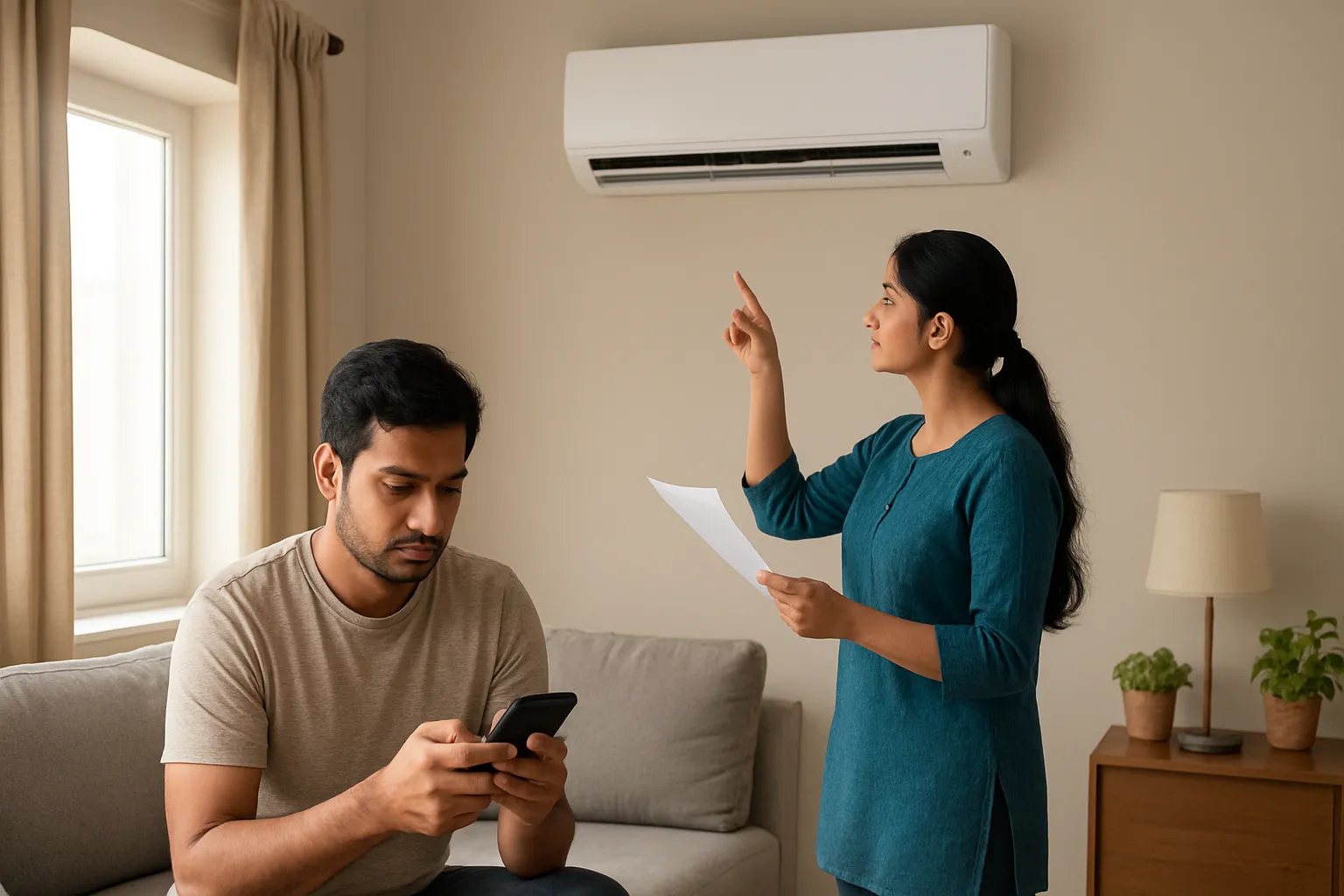
West Bengal Smart Meters 2026: AC bill track
TL;DR: West Bengal smart meters can help you track AC electricity use more clearly because they show consumption in kWh and, in many areas, give more frequent usage data through utility apps or portals. For AC owners, the useful method is simple: note your meter reading before and after AC use, estimate kWh per hour, multiply by your applicable tariff slab, and compare changes after setting temperature, servicing filters, or changing usage hours. Smart meters do not automatically reduce bills, but they make waste easier to spot.
Last updated: July 2026
Key takeaways
- A smart meter measures total home consumption, not only AC use, so isolate AC usage by checking readings before and after controlled cooling periods.
- In West Bengal, your actual bill depends on your distribution company, tariff category, slab, fixed charges, duties, taxes, and any prepaid/postpaid smart meter rules applicable in your area.
- A typical 1.5 ton inverter split AC may use roughly 0.8–1.8 units per hour depending on room heat, star rating, set temperature, outdoor temperature, and maintenance condition.
- Smart meter apps are most useful when you compare daily kWh patterns: non-AC days, AC-at-26°C days, and AC-at-22°C days.
- Higher BEE star ratings and inverter compressors matter most when the AC runs many hours daily during Kolkata, Howrah, Durgapur, Siliguri, Asansol, or district summer conditions.
- If your bill suddenly rises after smart meter installation, check load, appliance runtime, tariff slab movement, old meter averaging adjustments, and AC servicing before assuming meter error.
- Use 24–26°C, clean filters, sealed rooms, curtains, and fan support to reduce AC runtime without giving up comfort.
Table of contents
- What smart meters change for AC users in West Bengal
- How to read AC consumption from a smart meter
- AC bill math: simple examples for Bengal homes
- Smart meter app and portal checks to do every week
- Choosing an AC when you can track usage closely
- Why your AC bill may look higher after smart metering
- Practical habits that show up on the meter
- Checklist: AC bill tracking with a smart meter
- Practical next steps
- Conclusion
What smart meters change for AC users in West Bengal
Smart meters are becoming more common across India, including parts of West Bengal. For households using air conditioners, the biggest change is visibility. A traditional meter also records electricity accurately, but many families only look at the monthly bill. A smart meter can make consumption easier to monitor through display readings, utility portals, SMS alerts, or mobile apps where available.
For AC users, this matters because cooling is one of the highest electricity loads in a middle-class home. A refrigerator runs all day but at lower power. LED lights and fans are usually modest loads. A geyser is heavy but often used for short periods. An AC can run for 5–10 hours daily in summer, especially in bedrooms during humid nights or in living rooms during afternoon heat.
In West Bengal, AC usage is also affected by humidity. Kolkata and coastal-side areas can feel uncomfortable even when the temperature is not as high as dry regions because moisture slows sweat evaporation. Many homes therefore run ACs not only for cooling but also for dehumidification. Smart meter data helps you understand whether the AC is cycling normally or pulling high units due to heat load, leaky rooms, dirty filters, or low efficiency.
A smart meter does not identify your AC separately unless your home has a dedicated sub-meter or smart plug rated safely for the load. It records total home consumption. Still, you can track AC impact by using controlled comparisons. For example, check your meter at 10 pm before switching on the bedroom AC, avoid running other heavy appliances, then check again at 6 am. The difference gives an approximate overnight AC-plus-baseload consumption. Repeat the same test without AC on a cooler night to estimate the normal background load.
The focus keyword for this guide, west bengal smart meters ac bill track, is really about learning a habit: use the meter as a feedback tool, not just as a billing device.
How to read AC consumption from a smart meter
Most electricity meters display energy consumption in kWh, commonly called “units” in India. One unit means 1 kilowatt-hour. If an appliance uses 1,000 watts for one hour, it uses 1 unit. If it uses 500 watts for two hours, it also uses 1 unit.
To estimate AC consumption using a smart meter:
- Switch off or avoid using other heavy appliances such as geyser, washing machine heater, microwave, iron, pump, and induction cooktop during the test period.
- Note the meter reading in kWh before starting the AC.
- Run the AC for a fixed period, preferably 2–3 hours for a daytime test or full night for a realistic bedroom test.
- Keep the temperature setting, fan speed, door position, and number of people consistent.
- Note the meter reading again.
- Subtract the first reading from the second reading.
- Divide by hours to get approximate units per hour.
Example: If the meter reading is 1542.6 kWh at 11 pm and 1550.2 kWh at 7 am, the home used 7.6 units in 8 hours. If your non-AC overnight usage is about 1.2 units, the AC-related usage is around 6.4 units. That means roughly 0.8 unit per hour for that night.
This is only an estimate because refrigerators cycle, fans run, phone chargers draw a small load, and water pumps may switch on. But it is useful enough to compare settings and habits.
If your smart meter app provides 30-minute or hourly data, use it to identify AC spikes. A typical AC pattern may show high consumption in the first hour as the room cools down, then lower consumption as the inverter compressor slows. A fixed-speed AC may show more on-off cycling. If consumption remains high all night, check room leakage, filter condition, outdoor unit ventilation, and whether the AC is undersized for the room.
AC bill math: simple examples for Bengal homes
Electricity tariff varies by distribution company, consumer category, connected load, slab, and government updates. In West Bengal, households may be served by different utilities depending on location, such as CESC in Kolkata and nearby licensed areas, or WBSEDCL in many other parts of the state. Always verify your latest tariff from your bill or official utility communication.
For planning, you can use approximate bill math. Do not rely only on the AC’s rated power printed on the box because inverter ACs vary their power draw. Instead, estimate from actual meter readings or BEE energy labels.
Example 1: 1.5 ton inverter AC in a Kolkata bedroom
Assume:
- AC: 1.5 ton inverter split AC, 3-star or 5-star depending on model
- Use: 8 hours per night
- Approximate measured consumption: 0.8 unit/hour after the room stabilises
- Monthly use: 30 nights
Calculation:
- Daily AC units: 0.8 × 8 = 6.4 units
- Monthly AC units: 6.4 × 30 = 192 units
- If your effective per-unit cost after slab, fixed charges, duty, and tax works out around ₹7–₹9 per unit, the AC portion may be roughly ₹1,344–₹1,728 for the month.
This is not a guaranteed bill because slab movement can raise the effective rate. If total home consumption crosses higher slabs because of AC use, the marginal cost of AC units may be higher than the lowest slab shown on your bill.
Example 2: Older fixed-speed 1.5 ton AC in a hot room
Assume:
- AC: older fixed-speed 1.5 ton split/window AC
- Use: 6 hours daily
- Approximate consumption: 1.5 units/hour
- Monthly use: 30 days
Calculation:
- Daily AC units: 1.5 × 6 = 9 units
- Monthly AC units: 9 × 30 = 270 units
- At an approximate effective range of ₹7–₹9 per unit, the AC portion may be ₹1,890–₹2,430.
If the room gets direct afternoon sun, has a tin roof, poor sealing, or the AC is poorly serviced, the number can be higher.
Example 3: Short evening use in a small room
Assume:
- AC: 1 ton inverter split AC
- Use: 4 hours daily
- Approximate consumption: 0.55 unit/hour
- Monthly use: 25 days
Calculation:
- Monthly AC units: 0.55 × 4 × 25 = 55 units
- Approximate cost at ₹7–₹9 per unit: ₹385–₹495.
This is why runtime matters as much as tonnage. A larger AC used for long hours can dominate the bill, while a smaller efficient AC used briefly may remain manageable.
Smart meter app and portal checks to do every week
Your utility may provide a mobile app, web portal, SMS alerts, prepaid balance view, or consumption history depending on your area and meter rollout. The exact interface can differ, but the tracking logic remains the same.
Check these points weekly during summer:
- Daily kWh trend: Compare weekday and weekend consumption. A sudden jump usually means longer AC runtime or another heavy appliance.
- Night consumption: If your bedroom AC runs daily, note the units used between evening and morning.
- Peak use hours: If hourly data is available, identify when the AC starts pulling heavily. Afternoon use in west-facing rooms often costs more than night use because heat load is higher.
- Prepaid balance drop: For prepaid smart meters, observe how quickly balance reduces on AC-heavy days. Recharge planning becomes important before heatwave periods.
- Alerts and disconnection rules: Understand low-balance alerts, recharge posting time, and grace period rules if applicable. Do not wait until the last minute in peak summer.
- Bill comparison: Compare smart meter app units with the units shown in the monthly bill. Small timing differences can happen due to billing cycles, but large unexplained differences should be clarified with the utility.
Take screenshots or note weekly readings in a notebook. A simple log helps when you talk to an electrician, AC technician, landlord, or utility office.
Choosing an AC when you can track usage closely
Smart meters make AC efficiency more visible. If you are buying a new AC in 2026, look beyond the discount price and compare expected usage.
For most West Bengal bedrooms of around 100–140 sq ft, a 1 ton to 1.2 ton AC may be sufficient if the room is not top-floor, not heavily sun-facing, and has normal occupancy. For 140–180 sq ft rooms, 1.5 ton is common. Larger living rooms, top-floor flats, rooms with big glass windows, or south/west-facing heat exposure may need careful sizing. Oversizing can increase cost and discomfort through short cycling, while undersizing can make the compressor run continuously.
BEE star rating is important, especially for long runtime. A 5-star inverter model usually costs more upfront than a 3-star model, but the difference may recover over years if you use the AC daily for long periods. For occasional use, a good 3-star inverter AC may be financially sensible. Avoid comparing star ratings across old and new label periods without checking ISEER values, because BEE standards change over time.
Common 2026 buying choices include:
- 1 ton inverter split AC: Suitable for small bedrooms, study rooms, and lower heat-load spaces.
- 1.5 ton inverter split AC: Popular for medium bedrooms and compact living rooms.
- 1.5 ton 5-star inverter AC: Better for high nightly use, especially if summer usage crosses 6–8 hours daily.
- Window AC: May be cheaper upfront and easier to install in some older Kolkata flats, but split ACs usually offer more placement flexibility and lower noise.
- Fixed-speed AC: Can be acceptable for short use or lower budget, but smart meter readings may show higher unit consumption during long summer operation.
Also check warranty terms. Compressor warranty may be long, but PCB warranty, labour charges, gas charging, and installation quality matter. In humid Bengal conditions, outdoor unit corrosion protection and correct drainage are important. Ask the installer to maintain proper slope for drain pipe, use correct copper pipe thickness, vacuum the line where required, and avoid sharp bends.
Why your AC bill may look higher after smart metering
Some households feel their bill rises after a smart meter is installed. Sometimes the reason is actual higher summer consumption; sometimes it is tariff slab movement; sometimes an old meter had delayed or averaged readings. Before concluding that the meter is faulty, check these possibilities:
- You are using the AC more: Heatwaves, work-from-home routines, and night humidity can add hours without you noticing.
- Higher slab impact: AC units may push total monthly consumption into a higher tariff slab. The extra units are not always charged at the lowest rate.
- Old billing adjustment: If earlier bills were estimated or irregular, a new metering cycle may feel sharper because it reflects current usage more closely.
- Poor AC maintenance: Dirty filters, blocked outdoor coil, low refrigerant, or weak capacitor can increase power draw or runtime.
- Room heat leakage: Open gaps, uncurtained windows, kitchen heat, and frequent door opening make the AC work harder.
- Wrong set temperature: Running at 18–20°C in humid weather can greatly increase consumption compared with 24–26°C.
- Additional appliances: Geysers, pumps, refrigerators with poor seals, or old wiring losses may add to the same meter reading.
If readings seem abnormal, run a controlled load test with a qualified electrician. Do not open the meter box or tamper with seals. For official meter disputes, follow your electricity distribution company’s process.
Practical habits that show up on the meter
Smart meter tracking becomes powerful when you test one habit at a time. Try these changes for three to five days and compare daily kWh.
Set the AC to 24–26°C and use a ceiling fan at low or medium speed. The fan helps distribute cool air, so you feel comfortable at a higher temperature. In humid nights, use dry mode only if it suits your room conditions and your AC manual recommends it; dry mode is not a magic bill reducer in every situation.
Clean filters every two to four weeks during dusty months. A clogged filter reduces airflow and makes the AC run longer. If your indoor unit smells musty or cooling is weak, book professional service. Outdoor units should have open airflow around them. Do not cover the outdoor unit tightly while running, and avoid placing it in a closed balcony without ventilation.
Block direct sun with curtains, blinds, or reflective film where suitable. West-facing rooms in Bengal can absorb heat through walls and windows in the afternoon, then release it at night. Pre-cooling for a short time with doors closed can work better than switching on the AC late after the room has become extremely hot.
Keep doors and windows closed. Even a small gap can pull humid air into the room. In rented flats, simple door bottom seals or thick curtains can improve comfort. Avoid placing heat-generating devices such as gaming PCs, halogen lamps, or large open kitchens near the cooled zone.
Use timers. If you sleep comfortably after the room cools, set the AC timer for a few hours and let the fan continue. However, if switching off makes you wake up sweating and then restart the AC repeatedly, compare the meter data. Sometimes steady moderate operation is better than extreme cooling followed by repeated restarts.
Checklist: AC bill tracking with a smart meter
| Tracking task | What to record | Why it helps |
|---|---|---|
| Baseline night without AC | kWh used from bedtime to morning | Shows normal home load from fridge, fans, router, lights |
| AC night at 26°C | kWh used and outdoor weather condition | Gives realistic efficient-use estimate |
| AC night at 22°C | kWh used for same hours | Shows cost of lower temperature setting |
| Filter-cleaning comparison | Units before and after cleaning | Helps identify airflow-related waste |
| Weekend daytime use | Afternoon kWh with AC on | Captures high heat-load consumption |
| Monthly slab check | Total units on bill | Reveals whether AC use pushed you into higher slabs |
| Prepaid balance check | Recharge amount and days lasted | Helps plan summer recharge frequency |
| Service check | Cooling performance after technician visit | Confirms whether maintenance reduced runtime |
Practical next steps
- Find your latest electricity bill and note the consumer category, monthly units, and approximate effective per-unit cost.
- Check whether your smart meter data is available on your utility’s app, portal, SMS system, or meter display.
- Run a two-night comparison: one normal night without AC if possible, and one night with AC at 26°C.
- Estimate AC units per hour using meter readings, not just the wattage printed on the AC label.
- If buying a new AC, shortlist by tonnage, BEE star rating, ISEER, service network, installation quality, and warranty—not discount alone.
- Clean filters and inspect outdoor airflow before peak summer. If cooling is weak, call an authorised or experienced technician.
- Track daily kWh for one full billing cycle and mark AC-heavy days. This will make your next bill easier to understand.
- For prepaid smart meters, keep recharge buffer during May–September so cooling is not interrupted during high humidity or heatwave days.
Conclusion
West Bengal smart meters can make AC bills easier to understand, but the meter is only the measuring tool. The real savings come from reading the data, changing usage habits, maintaining the AC, and choosing the right capacity and efficiency for your room. If you track kWh before and after AC use, you can see the cost of every setting change—26°C versus 22°C, clean filter versus clogged filter, sealed room versus open door. That visibility is the main advantage of smart metering for AC owners in 2026.
About the author
AC Kharcha Team — research-focused AC guides for India. We study air conditioner specifications, electricity cost patterns, installation issues, and practical cooling habits to help Indian households make better AC decisions.
Frequently asked questions
Can a West Bengal smart meter show only my AC electricity use?
Usually no. A smart meter records total home electricity consumption. To estimate AC use, note readings before and after a fixed AC runtime while avoiding other heavy appliances. For exact AC-only tracking, you would need a safe dedicated sub-meter installed by a qualified electrician.
How many units does a 1.5 ton AC use per hour?
A 1.5 ton inverter AC may use roughly 0.8–1.8 units per hour depending on star rating, room heat load, set temperature, outdoor weather, and maintenance. Older fixed-speed ACs can be higher during long operation. Use your smart meter readings for a more realistic estimate.
Why did my electricity bill rise after smart meter installation?
Possible reasons include higher AC runtime, movement into a higher tariff slab, earlier estimated billing adjustments, poor AC maintenance, or other heavy appliances. Compare daily kWh data and run a controlled AC test before assuming the meter is faulty.
Is 26°C really cheaper than 22°C for AC use?
In most Indian homes, yes. A higher set temperature reduces compressor workload, especially when supported by a ceiling fan and a sealed room. Your smart meter can show the difference by comparing similar nights at 26°C and 22°C.
Do prepaid smart meters make AC bills cheaper?
Prepaid smart meters do not automatically make AC use cheaper. They can help you monitor balance and daily consumption more closely, which may encourage better habits. The actual cost still depends on tariff, units consumed, and applicable charges.
Which AC is better for smart meter tracking in Bengal, 3-star or 5-star?
For long daily use, a 5-star inverter AC can reduce energy consumption compared with a lower-rated model, though it usually costs more upfront. For short or occasional use, a good 3-star inverter may be reasonable. Compare ISEER, tonnage, price difference, and expected hours of use.
Should I complain if my smart meter reading seems too high?
First check your usage pattern, AC runtime, tariff slab, and other heavy appliances. Note readings with dates and screenshots if available. If the difference remains unexplained, contact your electricity distribution company through its official complaint process. Do not tamper with the meter.
Last updated: 31 Aug, 2026 · Verified by editorial team
About the author
AC Kharcha Editorial Team
AC research & buying guides · India · We research air conditioners, electricity costs, and home cooling practices across Indian climates, then publish practical guides so households can buy and run ACs more confidently.
View all articles →Share this guide
Was this article helpful?
Related posts
 AC electricity bill in India: city DISCOM cost and savings
Dry mode vs cool mode AC: Kolkata monsoon bill guide | AC Kharcha
For Kolkata’s monsoon, Dry Mode helps when the room feels sticky, while Cool Mode is better when the room is truly hot. Choose by room condition, not habit.
 AC electricity bill in India: city DISCOM cost and savings
MP AC Bill 2026: Indore/Bhopal 1.5 Ton AC Running Cost
MP AC bill 2026 for Indore and Bhopal homes: estimate 1.5 ton AC electricity cost, compare star ratings, and learn practical ways to reduce summer khoroch.
 AC electricity bill in India: city DISCOM cost and savings
Punjab PSPCL AC Bill 2026: 1.5 Ton Cost After 300 Free Units
Punjab PSPCL AC Bill 2026: 1.5 Ton Cost After 300 Free Units — a clear guide to estimating monthly AC electricity cost, understanding free-unit impact, and reducing summer bills.