
Delhi BSES 1.5 ton AC bill: monthly cost calculator | AC Kharcha
Estimate the monthly bill of a 1.5 ton AC in Delhi for BSES homes with practical 2026 examples, slab-rate cautions, star-rating guidance, and savings tips.
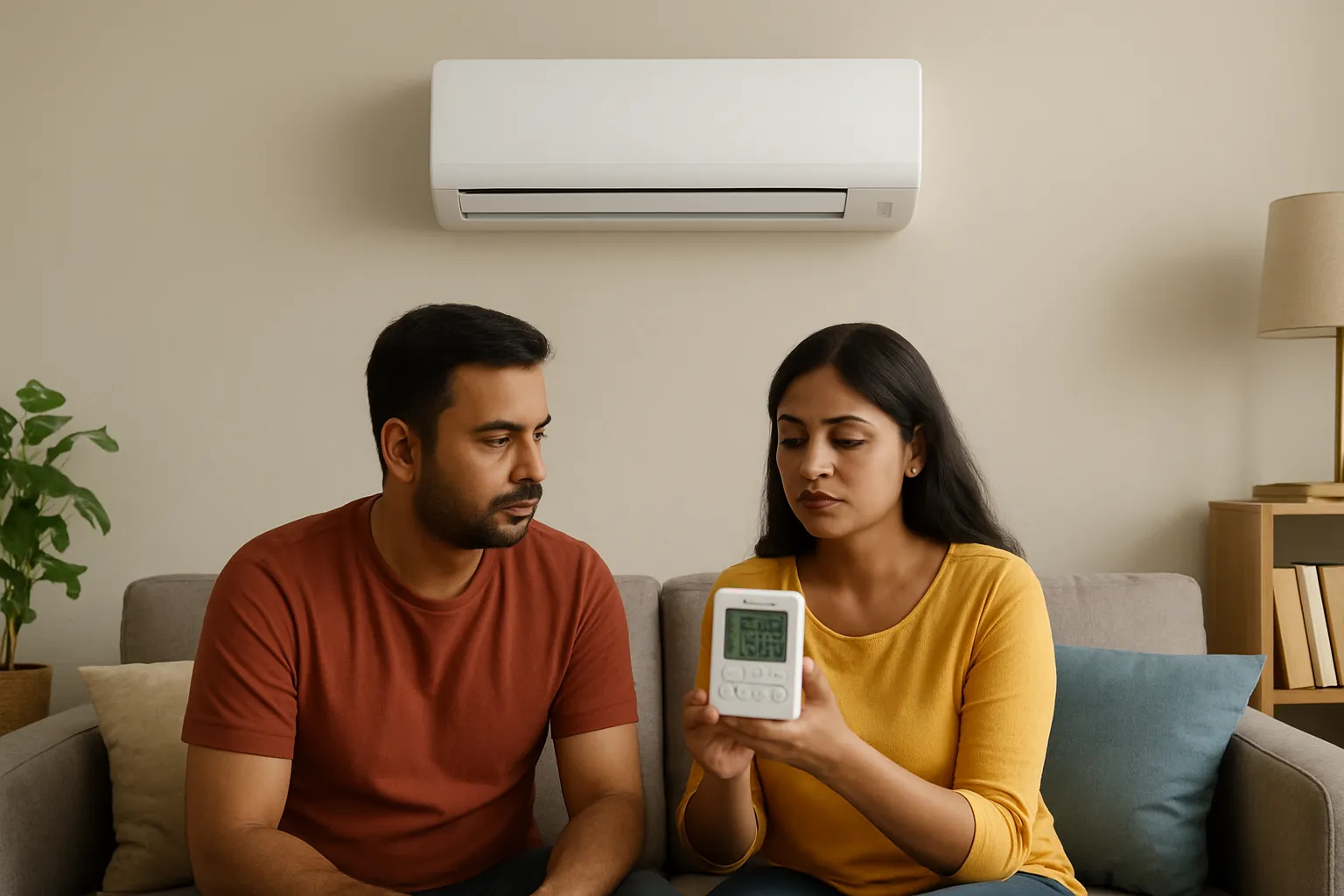
Delhi BSES 1.5 ton AC bill: monthly cost calculator
TL;DR: A 1.5 ton AC in Delhi can add roughly ₹1,200–₹5,000+ per month in peak summer depending on BSES slab, daily hours, star rating, room heat load, and temperature setting. For a quick estimate: monthly AC units = AC input power in kW × daily running hours × 30. Then multiply by your effective electricity rate, not just the lowest slab rate. Inverter 5-star models usually cost more upfront but can reduce bills for homes using AC for 6–10 hours daily.
Last updated: July 2026
Key takeaways
- A 1.5 ton AC does not always consume the same power; a fixed-speed unit may draw near 1.5–1.8 kW while an inverter AC keeps varying after the room cools.
- BSES bills in Delhi depend on consumption slabs, fixed charges, taxes/surcharges, subsidy eligibility, and your total household units — not AC usage alone.
- For bill estimates, use the model’s annual energy consumption label, ISEER rating, or rated input power instead of only tonnage.
- A 1.5 ton AC is usually suitable for many Delhi bedrooms and mid-size rooms, but top-floor, west-facing, poorly insulated rooms may need extra cooling capacity or heat control.
- Setting the AC at 24–26°C, cleaning filters, shading windows, and sealing air gaps can reduce compressor load without making the room uncomfortable.
- If your monthly household consumption crosses higher slabs because of AC use, the “extra” AC units may effectively cost more than the first few units.
Table of contents
- How to calculate a 1.5 ton AC bill in Delhi
- Understanding BSES billing before using any calculator
- Realistic 1.5 ton AC power use: inverter vs fixed-speed
- Delhi bill examples for 4, 8, and 12 hours of AC use
- BEE star rating impact on AC running cost
- Room factors in Delhi that change your AC bill
- Simple BSES AC bill calculator worksheet
- Ways to reduce your Delhi AC bill without suffering
- Buying and installation checks for Delhi homes
- Practical next steps
How to calculate a 1.5 ton AC bill in Delhi
The simplest Delhi AC bill calculation starts with electricity units, also called kWh. One unit of electricity is 1 kWh. If an appliance uses 1 kW for 1 hour, it consumes 1 unit.
Use this formula:
Monthly AC units = AC power input in kW × daily hours × number of days
Then:
Estimated AC cost = monthly AC units × effective per-unit electricity cost
For example, if your 1.5 ton AC averages 1.2 kW while running and you use it for 8 hours per day:
- 1.2 kW × 8 hours × 30 days = 288 units per month
- If your effective cost is ₹7 per unit, AC cost ≈ ₹2,016
- If your effective cost is ₹9 per unit, AC cost ≈ ₹2,592
This looks simple, but two things make real bills different. First, inverter AC power keeps changing based on room temperature and heat load. Second, BSES domestic bills use slabs and other charges, so the last 200–300 units added by AC may be billed at a higher effective rate if your total household consumption rises sharply.
For a useful estimate, calculate your AC units separately and then compare your total monthly consumption with and without AC. If your home normally uses 250 units without AC and the AC adds 300 units, your bill is not calculated as if all 550 units cost the same. Slab rates matter.
Understanding BSES billing before using any calculator
Delhi has different distribution companies depending on area. Many South, West, East, and Central Delhi households are served by BSES Rajdhani Power Limited or BSES Yamuna Power Limited. Your bill mentions the exact discom, sanctioned load, meter number, consumption units, subsidy details if applicable, fixed charges, energy charges, pension surcharge or other applicable components, and taxes.
Because tariffs can change through regulatory orders, treat all rupee examples in this guide as approximate. Before making a final budget, check your latest BSES bill and the current tariff schedule.
A good AC bill calculator for a BSES home should consider:
| Billing factor | Why it matters for AC cost | What to check on your bill |
|---|---|---|
| Monthly units | AC can double or triple summer consumption | Current and previous meter reading |
| Slab rate | Higher total use can push units into costlier slabs | Energy charge breakup |
| Fixed charge | Linked to sanctioned load and connection category | Fixed charge line item |
| Subsidy status | Delhi subsidy rules can affect payable amount | Subsidy/adjustment section |
| Taxes and surcharges | Final payable amount is more than energy charge alone | Total bill summary |
| Sanctioned load | Multiple ACs may exceed planned load | kW load mentioned on bill |
For one 1.5 ton AC, many homes run comfortably on their existing connection, but this depends on geysers, induction cooktops, second ACs, and other heavy appliances. If your MCB trips frequently when the AC starts, call a qualified electrician. Do not bypass protection devices.
Realistic 1.5 ton AC power use: inverter vs fixed-speed
A common mistake is assuming “1.5 ton” means the AC always consumes 1.5 units per hour. Tonnage is cooling capacity, not electricity consumption. A 1.5 ton AC roughly provides about 5.2 kW of cooling capacity, but its electrical input is lower and depends on efficiency.
Typical ranges for Indian 1.5 ton split ACs in 2026:
| AC type | Approximate input while actively cooling | Behaviour | Best for |
|---|---|---|---|
| 3-star fixed-speed split AC | 1.5–1.8 kW | Compressor turns fully on/off | Short use, lower purchase budget |
| 3-star inverter split AC | About 0.6–1.7 kW variable | Reduces speed after cooling | Mixed daily use |
| 5-star inverter split AC | About 0.4–1.5 kW variable | More efficient at part load | Long nightly use, high summer usage |
| Older window AC | 1.6–2.0 kW or more | Often less efficient if aged | Existing setup, limited space |
These are broad ranges. Your actual model may differ. Always check the BEE label, annual energy consumption figure, ISEER, and rated input power on the product specification sheet.
Inverter ACs can save electricity when they are correctly sized and run for long stretches. They cool the room, then slow down instead of repeatedly switching at full load. But if the room is very leaky, sun-heated, or the AC is undersized, even an inverter compressor may run hard for many hours. In that case, the bill advantage reduces.
Delhi bill examples for 4, 8, and 12 hours of AC use
Below are practical examples for a single 1.5 ton AC in a Delhi home. These are not official BSES calculations; they are planning estimates to help you understand the scale of cost. For simplicity, the examples use effective electricity costs of ₹6, ₹8, and ₹10 per unit. Your actual effective rate may be different after slabs, subsidy, fixed charges, and taxes.
| Daily AC use | Average AC draw | Monthly AC units | Cost at ₹6/unit | Cost at ₹8/unit | Cost at ₹10/unit |
|---|---|---|---|---|---|
| 4 hours/day | 1.0 kW | 120 units | ₹720 | ₹960 | ₹1,200 |
| 4 hours/day | 1.4 kW | 168 units | ₹1,008 | ₹1,344 | ₹1,680 |
| 8 hours/day | 1.0 kW | 240 units | ₹1,440 | ₹1,920 | ₹2,400 |
| 8 hours/day | 1.4 kW | 336 units | ₹2,016 | ₹2,688 | ₹3,360 |
| 12 hours/day | 1.0 kW | 360 units | ₹2,160 | ₹2,880 | ₹3,600 |
| 12 hours/day | 1.4 kW | 504 units | ₹3,024 | ₹4,032 | ₹5,040 |
This table explains why two neighbours can both have “1.5 ton AC” but very different bills. One may run a newer 5-star inverter for one bedroom at 26°C for 7 hours. Another may run an older fixed-speed AC in a top-floor drawing room at 20°C for 12 hours. The tonnage is the same, but the monthly units can be very different.
Also remember that AC units are added to your normal household load. Fans, refrigerator, TV, washing machine, lights, RO purifier, Wi-Fi router, laptop chargers, and kitchen appliances continue to consume electricity. In summer, refrigerators also work harder due to high ambient temperature.
BEE star rating impact on AC running cost
BEE star rating and ISEER are important when estimating a Delhi AC bill. A higher star rating generally means the AC delivers more cooling for each unit of electricity. But the right decision depends on your usage.
If you use the AC only occasionally for 2–3 hours on very hot days, a 5-star model may take many years to recover its higher purchase price. If you run AC for 8–10 hours almost every night from April to September, the higher efficiency can make a noticeable difference.
A rough way to compare models is to look at the annual energy consumption on the BEE label. Suppose two 1.5 ton inverter ACs have these approximate label values:
| Model type | Approx. annual energy consumption on label | Difference vs other model | What it means |
|---|---|---|---|
| 3-star inverter | 950–1,050 units/year | Higher | Lower purchase price, higher running cost |
| 5-star inverter | 750–850 units/year | Saves about 150–300 units/year | Higher purchase price, lower running cost |
If the efficient model saves 250 units a year and your effective electricity cost is ₹8 per unit, the yearly saving is around ₹2,000. If the price difference between the two ACs is ₹8,000–₹12,000, recovery may take around 4–6 years, depending on usage and tariff. Heavy users recover faster; light users recover slower.
Approximate 2026 market pricing for 1.5 ton split ACs in India may vary widely by brand, season, copper pipe inclusion, card offers, and installation charges. As a broad range, a 3-star inverter split AC may often be seen around ₹32,000–₹42,000, while a 5-star inverter split AC may be around ₹40,000–₹55,000 or higher for premium models. Treat these as approximate ranges, not fixed prices.
Room factors in Delhi that change your AC bill
Delhi’s summer heat is not gentle. Outdoor temperatures can cross 40°C, dust builds quickly on filters and coils, and many homes have sun-facing walls. Your AC bill depends heavily on the room, not just the machine.
Important room factors:
- Room size: A 1.5 ton AC is commonly used for roughly 120–180 sq ft rooms, but this is only a starting point.
- Floor level: Top-floor rooms under an exposed roof usually need more cooling because the slab stores heat.
- Sun direction: West-facing rooms heat strongly in the afternoon and evening.
- Window area: Large single-glass windows increase heat gain unless shaded by curtains, blinds, film, or external shade.
- Air leakage: Gaps under doors, open ventilators, and frequently opened doors make the compressor work longer.
- Occupancy: More people, computers, gaming PCs, and kitchen heat add load.
- Outdoor unit placement: Poor ventilation around the outdoor unit reduces heat rejection and increases power use.
If your 1.5 ton AC is struggling in a top-floor 180 sq ft room, buying a lower temperature setting is not the solution. The compressor will simply run harder. Improve shading, reduce hot air leakage, clean filters, and ensure the outdoor unit has clear airflow.
Simple BSES AC bill calculator worksheet
You can create a practical calculator in a notebook or spreadsheet. Use your actual bill and AC model details wherever possible.
| Step | Input | Example | Your value |
|---|---|---|---|
| 1 | AC average power draw | 1.2 kW | |
| 2 | Daily usage | 8 hours | |
| 3 | Days in billing month | 30 days | |
| 4 | AC monthly units | 1.2 × 8 × 30 = 288 units | |
| 5 | Normal home units without AC | 250 units | |
| 6 | Estimated total units | 250 + 288 = 538 units | |
| 7 | Effective cost per extra unit | ₹8/unit approx. | |
| 8 | Estimated AC energy cost | 288 × 8 = ₹2,304 |
How to choose average power draw:
- For an older fixed-speed 1.5 ton AC, use 1.5–1.8 kW for a conservative estimate.
- For a decent inverter AC, use 0.9–1.4 kW as a rough planning range for normal Delhi bedrooms.
- For a 5-star inverter in a well-sealed room at 25–26°C, average draw may be lower after the first cooling period.
- For top-floor, sunny, poorly insulated rooms, use the higher side of the range.
If you have a smart plug or energy meter rated safely for AC load, you can measure consumption more accurately. However, ACs are high-power appliances, so do not use cheap underspecified plugs or unsafe adapters. For permanent monitoring, ask an electrician about a proper energy meter in the circuit.
Ways to reduce your Delhi AC bill without suffering
The best savings come from reducing heat load and avoiding unnecessary compressor work. You do not need to switch off the AC all night if that ruins sleep; you need to run it intelligently.
Try these steps:
- Set 24–26°C instead of 18–20°C. Each lower degree increases compressor work. Many Delhi bedrooms feel comfortable at 25°C with a ceiling fan at low speed.
- Use the fan with the AC. A fan improves air movement and lets you use a higher temperature setting.
- Clean filters every 2–4 weeks in dusty months. Delhi dust can choke airflow quickly, especially near main roads or construction areas.
- Block afternoon sun. Use thick curtains, blinds, reflective film, or external shade on west-facing windows.
- Seal door gaps. A simple door bottom seal can reduce hot air entry.
- Use sleep or eco mode carefully. These modes can help if they maintain comfort, but performance varies by brand.
- Service before peak summer. Coil cleaning, drain check, fan inspection, and refrigerant pressure diagnosis should be done by trained technicians.
- Avoid heat sources inside the room. Ironing, cooking appliances, or high-end gaming PCs increase cooling load.
- Keep outdoor unit breathing. Do not box it into a tight balcony cabinet without airflow.
- Use timer settings. If early morning is cooler, schedule the AC to reduce or switch off instead of running at full setting till late morning.
Do not fall for unrealistic claims like “90% bill saving” from small plug-in devices. Real savings come from efficient equipment, correct sizing, good installation, and better usage habits.
Buying and installation checks for Delhi homes
If you are buying a new 1.5 ton AC for a BSES-served Delhi home, the bill impact should be part of the purchase decision.
Before buying, compare:
| Checkpoint | Why it matters | Good approach |
|---|---|---|
| BEE label year | Star ratings are updated periodically | Compare current labels, not old stock claims |
| ISEER | Better indicator than marketing slogans | Prefer higher ISEER within budget |
| Annual energy consumption | Helps estimate yearly units | Compare same capacity models |
| Warranty | PCB and compressor repairs can be costly | Read full warranty terms |
| Copper pipe length | Extra pipe adds cost | Confirm included length and per-metre rate |
| Installation quality | Poor vacuuming, bad flare joints, and wrong slope cause issues | Use authorised or skilled technicians |
| Outdoor location | Affects cooling and service access | Ensure shade/ventilation and safe mounting |
| Stabilizer need | Delhi voltage varies by locality/building | Follow brand guidance and electrician advice |
For example, brands such as LG, Daikin, Voltas, Blue Star, Hitachi, Panasonic, Lloyd, Carrier, Samsung, and Godrej commonly sell 1.5 ton inverter models in India. The right choice is not only the brand name. Check the exact model number, BEE star label, service availability in your area, installation cost, and warranty coverage.
Installation is not a formality. A well-installed mid-range AC can outperform a badly installed premium AC. Ask whether the technician will use a vacuum pump where required, properly insulate copper pipes, check drain slope, seal wall holes, and mount the outdoor unit with enough clearance. Poor installation can increase electricity use and shorten AC life.
Practical next steps
- Take your latest BSES bill and note your non-AC monthly units from a mild-weather month.
- Check your AC’s rated input power, BEE annual energy consumption, and star rating.
- Estimate AC units using kW × hours × days, then add them to your normal household consumption.
- Use an effective per-unit range such as ₹6–₹10 for planning, but verify with your latest tariff and bill slab.
- If buying new, compare 3-star and 5-star inverter models based on expected daily usage, not only sticker price.
- Improve the room first: curtains, sealing, filter cleaning, and outdoor airflow often reduce bills cheaply.
- If wiring is old, MCB trips, plug heats, or the AC shares a weak extension board, call a qualified electrician before regular use.
Conclusion
A Delhi AC bill for a 1.5 ton unit is not a single fixed number. For BSES consumers, the monthly impact depends on daily hours, AC efficiency, room heat load, and where your total household units fall in the tariff slabs. A practical estimate starts with monthly kWh and then applies a realistic effective unit rate. If you run AC for long hours, a good inverter model, correct installation, clean filters, and a 24–26°C setting can make a visible difference across the summer.
About the author
AC Kharcha Team — research-focused AC guides for India. We study AC specifications, electricity usage patterns, installation issues, and running-cost questions to help Indian households make clearer cooling decisions.
Frequently asked questions
How many units does a 1.5 ton AC consume in one hour in Delhi?
A 1.5 ton AC may consume roughly 0.8 to 1.8 units per hour depending on whether it is inverter or fixed-speed, its BEE rating, room heat load, and temperature setting. Older fixed-speed models often stay near the higher side while inverter models reduce power after cooling the room.
How much can a 1.5 ton AC add to a BSES bill per month?
For many Delhi homes, a 1.5 ton AC can add around ₹1,200 to ₹5,000 or more per month in summer. The range depends mainly on daily hours, effective slab rate, AC efficiency, and room conditions. Heavy 10–12 hour usage in a hot room can cost much more than short evening use.
Can I calculate my AC bill only by multiplying units by the lowest BSES slab rate?
No. Your AC units are added to your total household consumption. If AC use pushes your bill into higher slabs, the extra units may cost more than the lowest rate. Also consider fixed charges, taxes, surcharges, and subsidy status shown on your bill.
Is a 5-star inverter AC worth it for Delhi?
A 5-star inverter AC is usually more useful for Delhi homes that run AC for 6–10 hours daily during summer. The upfront cost is higher, but lower energy consumption can help over multiple seasons. For very occasional use, a 3-star inverter may be more economical.
What temperature setting gives a lower AC bill without discomfort?
Most users can start with 24–26°C and use a ceiling fan at low speed for better comfort. Setting 18–20°C increases compressor load and usually raises electricity consumption, especially in Delhi’s peak summer.
Does a 1.5 ton AC need a stabilizer in Delhi?
It depends on the AC model and voltage quality in your building. Many modern inverter ACs mention a wide operating voltage range, but local voltage fluctuations can still be an issue. Follow the manufacturer’s recommendation and consult a qualified electrician if voltage is unstable.
Why is my neighbour’s 1.5 ton AC bill lower than mine?
The difference may be due to star rating, inverter technology, daily usage hours, room size, floor level, sun exposure, filter condition, thermostat setting, and total household slab. Two 1.5 ton ACs can have very different monthly consumption.
Last updated: 06 Sep, 2026 · Verified by editorial team
About the author
AC Kharcha Editorial Team
AC research & buying guides · India · We research air conditioners, electricity costs, and home cooling practices across Indian climates, then publish practical guides so households can buy and run ACs more confidently.
View all articles →Share this guide
Was this article helpful?
Related posts
 AC electricity bill in India: city DISCOM cost and savings
Dry mode vs cool mode AC: Kolkata monsoon bill guide | AC Kharcha
For Kolkata’s monsoon, Dry Mode helps when the room feels sticky, while Cool Mode is better when the room is truly hot. Choose by room condition, not habit.
 AC electricity bill in India: city DISCOM cost and savings
MP AC Bill 2026: Indore/Bhopal 1.5 Ton AC Running Cost
MP AC bill 2026 for Indore and Bhopal homes: estimate 1.5 ton AC electricity cost, compare star ratings, and learn practical ways to reduce summer khoroch.
 AC electricity bill in India: city DISCOM cost and savings
Punjab PSPCL AC Bill 2026: 1.5 Ton Cost After 300 Free Units
Punjab PSPCL AC Bill 2026: 1.5 Ton Cost After 300 Free Units — a clear guide to estimating monthly AC electricity cost, understanding free-unit impact, and reducing summer bills.