LG vs Daikin AC: Which Is Better for Indian Heat?
LG vs Daikin AC: Which Is Better for Indian Heat? Compare cooling performance, electricity costs, features, service support, and buying tips for Indian homes.
LG vs Daikin AC: Which Is Better for Indian Heat?
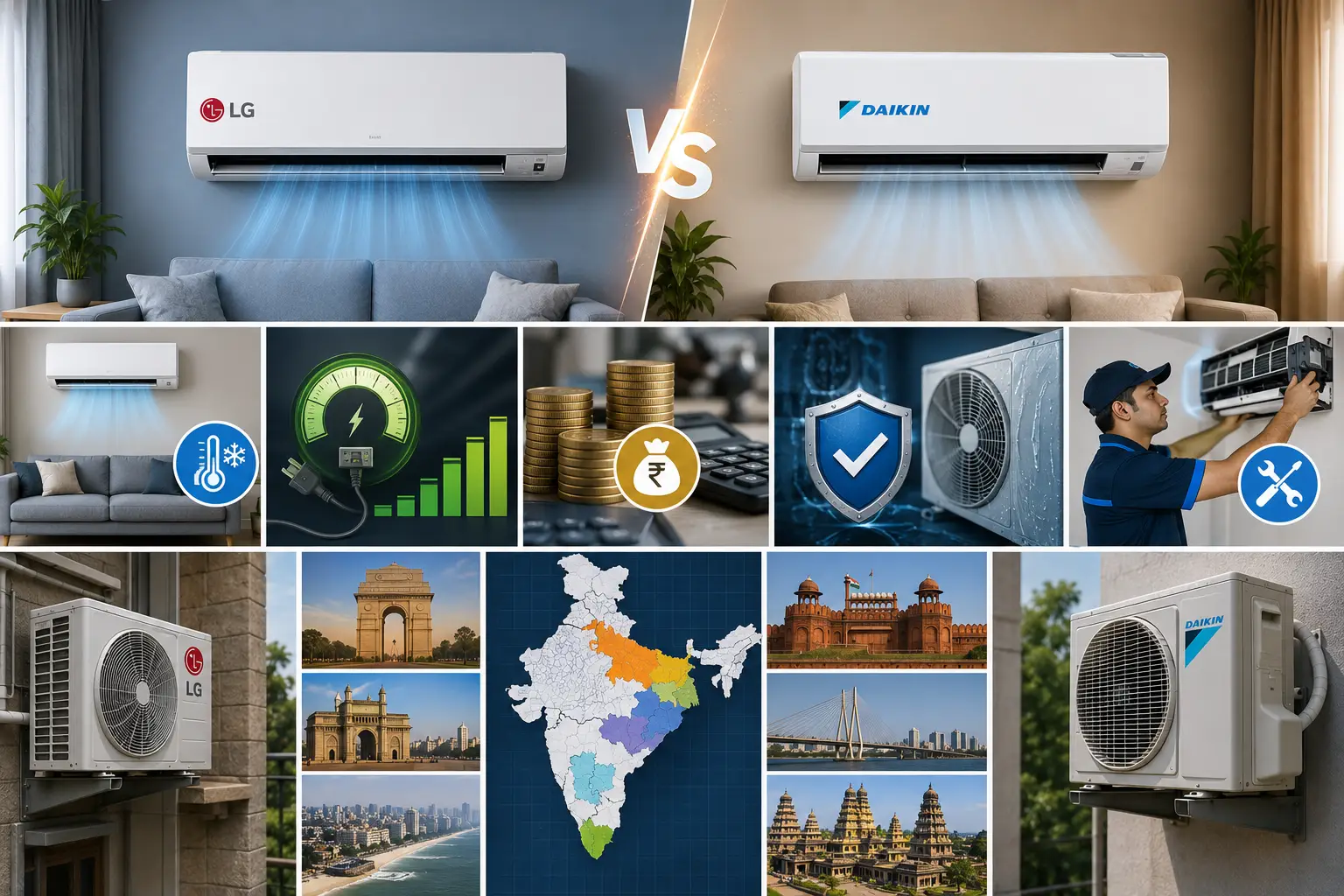
TL;DR: If your priority is a feature-rich AC with smart controls, convertible cooling modes, wide retail availability, and easy ownership, LG is often the safer pick for many Indian homes. If you want strong core cooling, quiet operation, and a brand known for air-conditioning engineering, Daikin is a serious choice—especially where service support is strong. For Indian heat, the better option depends less on the logo and more on correct tonnage, BEE star rating, installation quality, local service, and your daily running hours.
Last updated: July 2026
Key takeaways
- For long daily use in hot cities like Delhi, Jaipur, Ahmedabad, Nagpur, Lucknow, Hyderabad, and Kolkata, compare 5-star inverter models first; the electricity saving can matter over multiple summers.
- LG usually offers more consumer-facing features such as convertible modes, app/Wi-Fi options on selected models, dual inverter branding, HD filters, and wide online/offline availability.
- Daikin is valued for dependable cooling, low-noise indoor units on many models, strong compressor reputation, and a focused AC-first product image.
- Do not buy a 1.5 ton AC blindly. A 110 sq ft shaded bedroom may need less capacity than a 170 sq ft top-floor west-facing room.
- Installation quality can decide real performance. Poor vacuuming, bad drain slope, extra pipe bends, and weak wall brackets can make even an expensive AC perform badly.
- Check local service before finalising. In some towns LG service may be easier; in others Daikin dealer support may be excellent.
- The phrase “lg bonam daikin ac” is commonly searched by buyers comparing LG versus Daikin; the useful answer is not one fixed winner, but the right match for your room and usage.
Table of contents
- LG vs Daikin in India: the real difference
- Cooling performance in Indian summer conditions
- Electricity bill comparison: 3-star vs 5-star, LG vs Daikin
- Model ranges, tonnage, and BEE star choices
- Features that matter: LG strengths and Daikin strengths
- Service, warranty, installation, and spare parts
- Which brand suits which Indian home?
- Buying checklist before payment
- Usage and maintenance tips for lower bills
- Practical next steps
LG vs Daikin in India: the real difference
LG and Daikin both sell split ACs across popular Indian capacities such as 1 ton, 1.5 ton, and 2 ton. You will commonly see inverter split ACs with 3-star and 5-star BEE ratings, copper condensers, stabilizer-free operation claims within a voltage range, anti-corrosion coatings, sleep modes, turbo cooling, and filter-based air cleaning.
The difference is mainly in brand approach.
LG is a broad consumer electronics brand. Its ACs are often designed for users who want convenience features along with cooling. Many LG models highlight dual inverter compressor technology, convertible cooling, AI or smart diagnosis features, Wi-Fi on selected models, ocean black protection or similar anti-corrosion treatment, and easy access through large retailers.
Daikin is more air-conditioning focused. It is known globally for HVAC products, and in India many buyers consider Daikin when they want strong cooling fundamentals, simple operation, quiet indoor units, and a brand that is deeply associated with ACs rather than general appliances. Daikin models may not always look as feature-packed on paper at the same price, but many buyers shortlist them for reliability and cooling consistency.
For Indian heat, neither brand should be selected only because of reputation. A correctly sized 3-star Daikin may cool better than an undersized 5-star LG. A properly installed LG may run more efficiently than a badly installed Daikin. Brand matters, but sizing, installation, power supply, and maintenance matter just as much.
Cooling performance in Indian summer conditions
Indian homes create different cooling challenges. A bedroom in Bengaluru is not the same as a top-floor flat in Gurugram. A shaded room in Pune may cool quickly, while a west-facing room in Ahmedabad may remain hot even after sunset because walls store heat.
When comparing LG vs Daikin ACs, look at these cooling factors:
-
Tonnage and heat load
For many Indian bedrooms up to around 120 sq ft, a 1 ton or 1.2 ton AC may be enough if the room is shaded and not top-floor. For 130–170 sq ft rooms, 1.5 ton is commonly considered. For large living rooms, top-floor rooms, high ceilings, or heavy sun exposure, 2 ton may be needed. These are general ranges; local climate and insulation can change the answer. -
Outdoor temperature rating
Some models advertise operation at high ambient temperatures such as 52°C or 54°C. This can be useful in extreme heat zones, but do not treat it as the only measure of comfort. Correct installation and outdoor unit ventilation are equally important. -
Air throw and indoor unit placement
A powerful AC placed in a corner blocked by wardrobes may cool unevenly. Both LG and Daikin offer models with strong airflow, but the room layout decides how well that airflow reaches the bed, sofa, or work desk. -
Humidity control
In coastal and humid cities such as Mumbai, Chennai, Kochi, Kolkata, and Visakhapatnam, cooling alone is not enough. Dehumidification comfort matters. Both brands offer dry mode on many models, but user habits also matter. Running the AC at 24–26°C with the fan in auto mode often feels better than setting 18°C and forcing the compressor unnecessarily. -
Inverter performance at part load
Inverter ACs are useful because they can vary compressor speed instead of switching fully on and off repeatedly. In a well-sealed room, this can improve comfort and reduce power use during long running hours. Both LG and Daikin sell inverter models, so compare BEE label data rather than assuming all inverter ACs save the same amount.
Electricity bill comparison: 3-star vs 5-star, LG vs Daikin
Electricity bills are where many buyers get confused. The brand name does not directly tell you your monthly cost. The BEE star label, ISEER value, capacity, usage hours, thermostat setting, room heat load, and electricity tariff all contribute.
A practical bill estimate can be made like this:
Monthly AC cost = estimated units per day × number of days × tariff per unit
Suppose a 1.5 ton inverter AC uses an average of 0.8 to 1.2 units per hour depending on conditions. If you run it for 8 hours per night for 30 days, monthly consumption may roughly fall between:
- 0.8 × 8 × 30 = 192 units
- 1.2 × 8 × 30 = 288 units
If your effective electricity tariff is ₹7 per unit, the AC portion may be around ₹1,344 to ₹2,016 per month. If your slab rate is ₹9 per unit, it may be around ₹1,728 to ₹2,592 per month. These are approximate examples, not guaranteed bills.
A 5-star model usually costs more upfront than a 3-star model, but if you use the AC heavily, the saving can become meaningful. For a guest room used only occasionally, a 3-star inverter AC may be financially sensible. For a master bedroom used every night for 5–7 months, a 5-star LG or Daikin model is worth comparing carefully.
Approximate ownership comparison
| Buyer situation | Better priority | Why it matters | LG vs Daikin angle |
|---|---|---|---|
| 6–10 hours daily summer use | 5-star inverter, high ISEER | Electricity cost adds up fast | Compare exact BEE label values, not only brand |
| 2–3 hours occasional use | Reasonable 3-star inverter | Upfront price may matter more | Choose the brand with better local deal and service |
| Humid coastal city | Dry mode, anti-corrosion protection | Comfort and outdoor unit life | Check coating details and service access |
| Very hot north/west India | Correct tonnage, strong airflow, outdoor ventilation | Peak heat stresses ACs | Either brand works if sized and installed well |
| Rental flat | Installation cost, relocation policy, service ease | You may shift later | LG may be easier in some markets; verify locally |
| Noise-sensitive bedroom | Low indoor noise rating | Sleep comfort matters | Daikin often gets shortlisted; compare model dB ratings |
Model ranges, tonnage, and BEE star choices
Exact model numbers change every season, so check current 2026 listings before purchase. Still, the broad choices are predictable.
Common LG AC options in India
LG commonly sells split inverter ACs in 1 ton, 1.5 ton, and 2 ton categories. You may find 3-star and 5-star models with features such as dual inverter compressor, convertible cooling modes, ocean black protection on selected components, HD filter, auto clean, smart diagnosis, and Wi-Fi on selected higher variants. Approximate prices can vary widely by season and platform, but many 1.5 ton inverter split ACs from LG may fall roughly in the ₹35,000–₹55,000 range depending on star rating and features. Premium models can cost more.
Common Daikin AC options in India
Daikin also sells 1 ton, 1.5 ton, and 2 ton split inverter ACs across 3-star and 5-star categories. Typical highlights include inverter compressor, copper condenser, PM filter or dust filter depending on model, Coanda airflow on some models, quiet operation, high ambient cooling claims on selected units, and sturdy cooling-focused design. Approximate prices for many 1.5 ton inverter Daikin split ACs may also be around ₹35,000–₹55,000, with variation by star rating, retailer, installation offers, and seasonal discounts.
1 ton vs 1.5 ton vs 2 ton
- 1 ton: Small bedrooms, shaded study rooms, compact children’s rooms, usually up to about 100–120 sq ft in moderate conditions.
- 1.5 ton: The most common Indian bedroom choice, often suitable for around 120–170 sq ft depending on sun exposure and city climate.
- 2 ton: Larger bedrooms, living rooms, top-floor rooms, rooms with large windows, or very hot climates.
If the room is on the top floor, has a tin/terrace roof, large west-facing glass, poor curtains, or many appliances, move your estimate upward. If the room is shaded, insulated, and used by one or two people, you may not need to overspend on capacity.
Features that matter: LG strengths and Daikin strengths
When buyers search for “lg bonam daikin ac”, they often want a straight winner. A more useful answer is to separate real benefits from brochure noise.
LG strengths
- Feature-rich models: LG often packs models with convertible cooling, smart diagnosis, app connectivity on selected variants, and user-friendly remote modes.
- Retail availability: LG is widely available in large electronics stores, online marketplaces, and local dealers across India.
- Consumer-friendly interface: Many users find LG remotes, display indicators, and mode labels easy to understand.
- Good option for families: If different family members use the AC differently—night sleep, afternoon cooling, quick cooling after office—convertible modes can be convenient.
- Broad appliance service network: In many urban and semi-urban areas, LG’s service reach is a practical advantage.
Daikin strengths
- Cooling-first brand image: Daikin is strongly associated with air-conditioning and HVAC systems.
- Quiet operation on many models: Daikin is often shortlisted for bedrooms where low noise matters.
- Simple, focused operation: Some buyers prefer Daikin because it avoids excessive gimmicks and focuses on cooling comfort.
- Strong dealer-led support in many cities: In areas with active Daikin dealers, installation and service experience can be very good.
- Good choice for heat-heavy rooms: Correctly sized Daikin inverter ACs are popular for steady cooling in demanding Indian summers.
Features you should verify instead of assuming
| Feature | What to check before buying | Why it matters |
|---|---|---|
| BEE star rating | Current year star label and ISEER value | Old stock may have different efficiency ratings |
| Warranty | Comprehensive warranty, PCB warranty, compressor warranty | Inverter PCB repairs can be costly outside warranty |
| Condenser | Copper condenser and coating details | Helps durability and serviceability |
| Noise | Indoor unit dB rating at low fan speed | Important for bedrooms and study rooms |
| Voltage range | Stabilizer-free operating range | Useful in areas with voltage fluctuation |
| Installation kit | Copper pipe length included, drain pipe, bracket charges | Prevents surprise costs at delivery time |
| Service availability | Nearby authorised service or trusted dealer | Reduces downtime in peak summer |
Service, warranty, installation, and spare parts
A good AC can disappoint if installation is rushed. Before choosing LG or Daikin, ask the seller these questions:
- Who will install the AC: brand technician, dealer technician, or third-party installer?
- Is standard installation included, or charged separately?
- How much copper pipe is included? What is the cost per extra metre?
- Will the technician use a vacuum pump before releasing refrigerant?
- Are outdoor unit brackets included?
- What are the drain pipe and electrical wiring charges?
- Is the wall core cutting included?
- What warranty applies if installation is not done by authorised personnel?
Vacuuming is especially important in split AC installation. It removes air and moisture from the refrigerant line. Skipping it may not cause an immediate visible issue, but it can hurt long-term performance and reliability. Many buyers focus on discounts and forget this step.
Also check spare part access. LG parts may be easier to find in some markets because of its broad appliance network. Daikin parts may be easily available where authorised dealers are active. The “better” brand can change from city to city. A buyer in Kolkata, Surat, Patna, Guwahati, Indore, or Kochi should ask locally rather than relying only on national reputation.
Which brand suits which Indian home?
Choose LG if…
- You want a modern feature set with convertible cooling and smart options.
- Your family prefers easy controls and visible operating modes.
- LG service is strong in your locality.
- You are buying online and want many model choices and frequent discounts.
- You want an AC that balances cooling, convenience, and after-sales familiarity.
Choose Daikin if…
- Your priority is dependable cooling and quiet operation.
- You prefer a brand strongly focused on air-conditioning.
- You have a good Daikin dealer or service centre nearby.
- You do not need too many smart features.
- You are cooling a heat-heavy room and want a straightforward performance-oriented AC.
For 1.5 ton 5-star inverter buyers
This is the most competitive category. Compare current LG and Daikin 1.5 ton 5-star inverter ACs by ISEER, annual energy consumption on the BEE label, warranty, included installation kit, noise level, and final installed price. If LG is ₹3,000–₹5,000 cheaper with similar efficiency and better service in your area, LG may be better value. If Daikin has a comparable price, lower noise, and stronger local dealer support, Daikin may be the better long-term pick.
For budget buyers
If the budget is tight, do not automatically chase the lowest online price. Sometimes a slightly costlier unit from a reliable local dealer includes better installation support. A cheap AC with poor installation, extra hidden charges, and slow service can become expensive later.
Buying checklist before payment
Use this checklist in the shop or before placing an online order.
| Checkpoint | LG | Daikin | Your note |
|---|---|---|---|
| Correct tonnage for room | ☐ | ☐ | Measure room and note sunlight |
| Current BEE star label checked | ☐ | ☐ | Compare ISEER and annual units |
| Final installed price known | ☐ | ☐ | Include bracket, pipe, drain, wiring |
| Local service confirmed | ☐ | ☐ | Ask neighbours or local dealer |
| Warranty terms clear | ☐ | ☐ | Compressor, PCB, gas leakage conditions |
| Noise rating checked | ☐ | ☐ | Especially for bedroom use |
| Outdoor unit location approved | ☐ | ☐ | Ventilation and safe access |
| Stabilizer need assessed | ☐ | ☐ | Depends on voltage quality |
Do not ignore the outdoor unit location. It should have enough clearance for hot air to escape. A unit trapped in a closed balcony, tight shaft, or direct recirculation zone will struggle. This increases power use and can reduce cooling performance.
Usage and maintenance tips for lower bills
After buying LG or Daikin, your habits decide the monthly bill.
- Set 24–26°C for routine use. Every degree lower can increase power consumption, especially in hot weather.
- Use ceiling fan with AC. A fan helps circulate cool air, allowing a comfortable thermostat setting.
- Clean filters regularly. In dusty Indian conditions, clean filters every 2–4 weeks during heavy use. Follow the manual for your model.
- Seal air leaks. Gaps under doors, open ventilators, and unsealed windows make the AC work harder.
- Use curtains or blinds. Blocking afternoon sun can reduce heat load significantly.
- Service before peak summer. March or early April service is often better than waiting for May when technicians are overloaded.
- Keep outdoor unit clear. Remove leaves, plastic, dust blockage, and anything restricting airflow.
- Do not repeatedly switch off and on. Inverter ACs work best when allowed to stabilise at the set temperature.
If cooling suddenly drops, do not keep running the AC for weeks hoping it will improve. Possible causes include dirty filters, clogged indoor coil, gas leakage, faulty sensor, blocked outdoor coil, or installation issue. Call an authorised technician for refrigerant, electrical, PCB, or compressor-related work.
Practical next steps
- Measure your room length, width, ceiling height, and note whether it is top-floor or west-facing.
- Decide your expected daily runtime: occasional, 4–6 hours, or 8+ hours.
- Shortlist one LG and one Daikin model in the same tonnage and star rating.
- Compare BEE label annual consumption, ISEER, warranty, noise level, and final installed price.
- Call local service numbers or ask nearby buyers about response time in your city.
- Confirm installation scope in writing before delivery.
- After installation, check cooling, drain flow, remote functions, outdoor unit vibration, and warranty registration.
Conclusion
There is no universal winner between LG and Daikin for every Indian home. LG is often better for buyers who want more features, easy availability, and a familiar service network. Daikin is often better for buyers who value quiet, steady, cooling-focused performance and have good local dealer support.
For Indian heat, the smartest decision is to compare equal models: same tonnage, same BEE star level, similar warranty, and similar final installed price. Then choose the brand that fits your room, your usage hours, and your local service reality. A correctly sized and well-installed AC from either LG or Daikin will serve you better than a famous model bought without planning.
About the author
AC Kharcha Team — research-focused AC guides for India. We study air-conditioner features, electricity cost factors, installation practices, and ownership issues so Indian households can make clearer cooling decisions.
Frequently asked questions
Which is better for Indian heat, LG or Daikin AC?
Both can work well in Indian heat if the tonnage and installation are correct. LG is usually stronger on features and wide availability, while Daikin is often preferred for quiet, cooling-focused performance. Compare the exact model, BEE rating, ISEER, warranty, and local service before choosing.
Is LG AC more power-saving than Daikin?
Not automatically. Power saving depends on the specific model’s BEE star rating, ISEER value, room heat load, usage hours, and thermostat setting. A 5-star LG may consume less than a 3-star Daikin, but a 5-star Daikin may beat a lower-efficiency LG. Always compare the BEE label.
Is Daikin AC worth buying over LG?
Daikin is worth considering if you prioritise steady cooling, low noise, and have good Daikin service support nearby. However, if LG offers a similar efficiency rating, better installed price, and stronger service in your area, LG may be the better practical choice.
Which is better for a 1.5 ton 5-star inverter AC, LG or Daikin?
In the 1.5 ton 5-star inverter category, compare ISEER, annual energy consumption, indoor noise rating, warranty on compressor and PCB, installation charges, and final price. Choose LG for richer features and convenience, or Daikin for a simpler cooling-focused option if service is good locally.
What tonnage should I choose for an Indian bedroom?
A small shaded bedroom may work with 1 ton, while many medium bedrooms need 1.5 ton. Large rooms, top-floor rooms, west-facing rooms, or spaces with big windows may need 2 ton. Room size, sunlight, insulation, city climate, and occupancy all matter.
Are LG and Daikin AC prices exact online?
No. Prices change by city, season, retailer, card offer, installation package, and stock year. Treat prices as approximate ranges and confirm the final installed cost, including copper pipe, wall bracket, drain pipe, wiring, and any stabilizer.
Do LG and Daikin ACs need a stabilizer?
Many modern inverter ACs claim stabilizer-free operation within a specified voltage range, but this does not protect against every power issue. If your area has frequent voltage fluctuation, ask an authorised technician or electrician whether a suitable stabilizer or protection device is needed.
How can I reduce the electricity bill after buying an LG or Daikin AC?
Use 24–26°C for regular cooling, keep doors and windows sealed, clean filters every few weeks in dusty months, use curtains against direct sun, run a ceiling fan for air circulation, and service the AC before peak summer. Correct installation also helps efficiency.
Last updated: 06 Sep, 2026 · Verified by editorial team
About the author
AC Kharcha Editorial Team
AC research & buying guides · India · We research air conditioners, electricity costs, and home cooling practices across Indian climates, then publish practical guides so households can buy and run ACs more confidently.
View all articles →Share this guide
Was this article helpful?