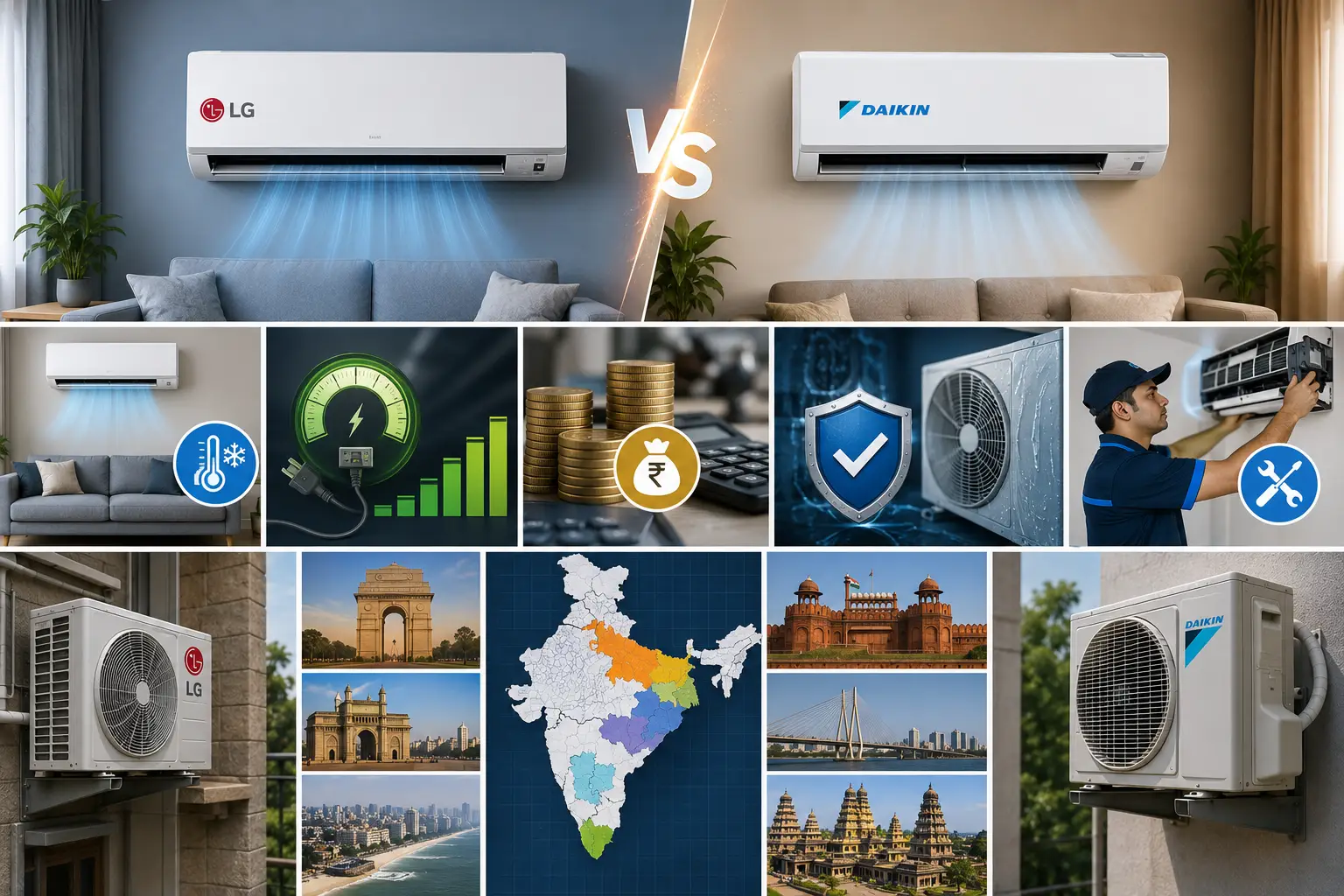
1 Ton 5-Star AC 2026: Voltas Vectra Zen vs Blue Star Q Smart Wi-Fi
A practical India-focused comparison of Voltas Vectra Zen and Blue Star Q Smart Wi-Fi 1 ton 5-star inverter ACs, including room fit, electricity cost, features, installation checks and buying tips.
1 Ton 5-Star AC 2026: Voltas Vectra Zen vs Blue Star Q Smart Wi-Fi
TL;DR: If you need a 1 ton 5-star inverter AC for a small Indian bedroom, study room or compact home office, both Voltas Vectra Zen and Blue Star Q Smart Wi-Fi are worth shortlisting. Choose Voltas Vectra Zen if your priority is a familiar mass-market service network, straightforward cooling and a value-focused purchase. Choose Blue Star Q Smart Wi-Fi if app control, smart scheduling and a more feature-rich ownership experience matter to you. Before buying either, verify the exact 2026 BEE label, ISEER, warranty terms, installation charges and service availability in your city.
Last updated: July 2026
Key takeaways
- A 1 ton 5-star AC is best suited for roughly 90–120 sq ft rooms in many Indian cities, but top-floor rooms, west-facing walls and poor insulation may need a higher capacity.
- Voltas Vectra Zen and Blue Star Q Smart Wi-Fi compete in the same practical buying zone: small-room cooling, inverter efficiency and lower running cost than lower-star models.
- Blue Star’s Q Smart Wi-Fi appeal is stronger if you want phone control, scheduling and smart convenience; Voltas Vectra Zen is attractive if you want simple operation and broad brand familiarity.
- The real cost difference is not just the selling price. Compare electricity consumption, installation accessories, stabilizer need, extended warranty and local service response.
- Do not buy only by the phrase “5-star”. Check the current BEE label year, ISEER value, annual energy consumption estimate and model number on the brand or retailer listing.
- Good installation matters as much as the model. Wrong copper pipe length, poor vacuuming, bad drainage or weak electrical wiring can spoil the performance of even a good AC.
Table of contents
- Who should consider a 1 ton 5-star AC in 2026?
- Voltas Vectra Zen vs Blue Star Q Smart Wi-Fi: quick comparison
- Room size, heat load and tonnage: where 1 ton works
- Electricity bill estimate for Indian homes
- Cooling comfort, noise and daily use experience
- Smart Wi-Fi features: useful or unnecessary?
- Installation, warranty and service checks before payment
- Which one should you buy?
- Practical next steps
- Conclusion
Who should consider a 1 ton 5-star AC in 2026?
A 1 ton 5-star inverter AC is a sensible choice for Indian homes where the room is compact and the AC runs for many hours during summer. Typical examples include a small bedroom, children’s study room, work-from-home cabin, rented flat bedroom or guest room. The “5-star” part matters most when the AC runs regularly, because the higher upfront price can be balanced by lower electricity use over multiple seasons.
For occasional use, such as one or two hours on very hot nights, a 3-star AC may sometimes be more economical upfront. But for cities like Delhi, Jaipur, Ahmedabad, Nagpur, Lucknow, Hyderabad, Chennai, Kolkata or Pune, where summer use can stretch across months, a 5-star inverter AC deserves serious consideration.
The focus keyword here, 1 ton 5 star ac voltas vectra zen blue star q smart wifi, reflects a very specific buying decision. You are not just choosing a brand; you are choosing how you want to live with the AC. Do you want simple cooling with dependable local support? Do you want Wi-Fi control and smart scheduling? Do you care more about the lowest net price after card offers, or the lowest running cost over five years? These questions are more useful than comparing only headline discounts.
Approximate online and offline prices for 1 ton 5-star inverter split ACs in 2026 can vary widely, often around ₹34,000–₹48,000 depending on season, city, copper kit inclusion, card discounts and installation offers. Treat any price as temporary. AC prices in India change quickly before peak summer, during festive sales and when BEE label updates affect old stock.
Voltas Vectra Zen vs Blue Star Q Smart Wi-Fi: quick comparison
The exact specifications can differ by model suffix and manufacturing year, so always verify the current product page before ordering. Still, the practical comparison below captures how many Indian buyers will evaluate these two options.
| Factor | Voltas Vectra Zen 1 Ton 5-Star | Blue Star Q Smart Wi-Fi 1 Ton 5-Star | What it means for you |
|---|---|---|---|
| Best fit | Buyers wanting straightforward cooling from a widely known Indian AC brand | Buyers wanting connected control and smart convenience | Match the model to your usage habits, not just the discount |
| Cooling category | 1 ton inverter split AC | 1 ton inverter split AC with Wi-Fi focus | Both are aimed at small rooms |
| Energy rating | Check latest BEE 5-star label and ISEER | Check latest BEE 5-star label and ISEER | Do not rely on old screenshots or expired labels |
| Smart control | May be limited or model-dependent | Wi-Fi/app control is a key selling point | Useful if you pre-cool rooms or manage AC remotely |
| Service perception | Strong mass-market presence in many cities | Established AC specialist brand with strong urban presence | Ask local dealers about response time in your PIN code |
| Price positioning | Often value-focused depending on offers | May cost more if smart features are included | Compare final invoice, not MRP |
| Ideal user | Simple remote-control use, rental homes, family bedrooms | App users, tech-friendly homes, scheduled night cooling | Convenience may justify price difference for some buyers |
This table should not be treated as a substitute for the latest spec sheet. Brands often sell multiple variants under similar names. A small change in model code can affect Wi-Fi support, warranty, ISEER, refrigerant, filters or included accessories.
Room size, heat load and tonnage: where 1 ton works
A 1 ton AC is not automatically right for every small room. In India, heat load changes dramatically with floor level, wall direction, window size and city climate. A 110 sq ft bedroom in Bengaluru may behave differently from a 110 sq ft top-floor room in Jaipur.
As a general starting point, a 1 ton inverter AC can work well for:
- 90–120 sq ft bedroom with normal ceiling height
- One or two occupants most of the time
- Limited direct afternoon sunlight
- Reasonably sealed doors and windows
- Curtains or blinds on large windows
- Non-top-floor rooms with moderate heat gain
You should reconsider 1 ton and examine 1.2 ton or 1.5 ton options if:
- The room is on the top floor under a heated terrace
- The room has a large west-facing glass window
- The city regularly sees 42–45°C summer afternoons
- The room has multiple heat-producing devices, such as gaming PC, desktop workstation or large TV
- Three or more people use the room for long periods
- The room is around 130 sq ft or larger with poor insulation
An undersized AC may run continuously and still not cool well in peak heat. An oversized AC may cool quickly but cycle poorly, reduce dehumidification comfort and cost more upfront. Inverter ACs handle load variation better than old fixed-speed units, but tonnage still matters.
For both Voltas Vectra Zen and Blue Star Q Smart Wi-Fi, take the time to measure the room. Do not estimate by memory. Measure length and width, multiply for square feet, and then note extra heat factors such as top-floor exposure, number of windows and direct sun.
Electricity bill estimate for Indian homes
The biggest reason to consider a 5-star model is running cost. A 1 ton inverter AC does not consume one fixed number of units every hour. It draws more power during initial cooling and less after the room reaches the set temperature. Actual consumption depends on outdoor temperature, set point, insulation, fan speed and maintenance condition.
Still, you can create a rough bill estimate before purchase. Suppose a 1 ton 5-star inverter AC averages around 0.45–0.75 kWh per hour during mixed real-world use. This is only an estimate; check the BEE annual consumption figure for the exact model.
| Daily use pattern | Assumed average consumption | Monthly units for 30 days | Bill at ₹7/unit | Bill at ₹10/unit |
|---|---|---|---|---|
| 4 hours/night | 0.55 kWh/hour | 66 units | ₹462 | ₹660 |
| 6 hours/night | 0.55 kWh/hour | 99 units | ₹693 | ₹990 |
| 8 hours/night | 0.55 kWh/hour | 132 units | ₹924 | ₹1,320 |
| 10 hours/day | 0.60 kWh/hour | 180 units | ₹1,260 | ₹1,800 |
These numbers are approximate. Your actual bill can be lower or higher. If you set the AC to 18°C in a hot top-floor room, consumption will rise. If you set 25–26°C, use ceiling fan support and reduce heat leakage, consumption may improve.
Many Indian households make the mistake of comparing only the purchase price. Suppose one model costs ₹3,000 more but saves even ₹300–₹500 per month during heavy summer use compared with a lower-efficiency alternative. Over multiple seasons, efficiency can matter. Between Voltas Vectra Zen and Blue Star Q Smart Wi-Fi, compare the ISEER and annual energy consumption values on the current BEE label, because those are more useful than broad advertising claims.
Also remember tariff slabs. In many states, using an AC pushes the household into a higher slab for some units. So the last units consumed in the month may effectively cost more than your average tariff. If your bill already sits near a slab boundary, efficient operation becomes even more valuable.
Cooling comfort, noise and daily use experience
The best AC is not only the one that cools fastest. For bedrooms, comfort depends on stable temperature, low noise, proper airflow and humidity control. A 1 ton inverter AC should be able to reduce compressor speed after the room reaches the set point, making sleep more comfortable than frequent on-off cycling.
Voltas Vectra Zen may appeal to users who want a familiar remote, simple modes and uncomplicated family use. In many homes, parents or elders prefer a physical remote and standard buttons over app-based controls. If your AC will be used mostly at night and you rarely change settings, simplicity is an advantage.
Blue Star Q Smart Wi-Fi becomes interesting when daily routines are predictable. You may want the room to start cooling 15 minutes before bedtime, switch to a higher temperature after midnight, or turn off automatically when you forget. Smart features can reduce waste if used properly. However, Wi-Fi does not improve cooling capacity by itself. It improves control.
Noise levels should be checked in the specification sheet, especially indoor unit noise at low fan mode. For bedrooms, a quieter indoor unit can matter more than an extra filter name. Also ask where the outdoor unit will sit. A badly mounted outdoor unit can create vibration noise even if the AC itself is well designed.
Air throw is another practical point. In a long narrow room, the indoor unit placement can decide comfort. If the air does not reach the bed or desk area properly, you may feel warm spots. During installation, avoid placing the indoor unit directly above electronics or where cold air hits your face all night.
Smart Wi-Fi features: useful or unnecessary?
Blue Star Q Smart Wi-Fi’s biggest differentiator is connectivity. For some homes, this is genuinely useful. For others, it becomes a novelty after the first week.
Wi-Fi AC features can be useful if:
- You often forget to switch off the AC
- You want to pre-cool the room before reaching home
- You prefer app schedules instead of timer buttons
- You manage AC use for elderly parents or children from another room
- You want to monitor settings without searching for the remote
- Your daily sleep routine is consistent
Wi-Fi may be unnecessary if:
- Internet connectivity is unstable in the room
- You prefer using only the physical remote
- The AC is in a rental room with changing Wi-Fi passwords or router placement
- You are not comfortable installing and maintaining brand apps
- You do not want another connected device in the home
If choosing Blue Star Q Smart Wi-Fi specifically for smart features, check whether the app supports your phone, whether setup requires 2.4 GHz Wi-Fi, and whether all important functions are available through the app. Also check if the AC remains fully usable with the normal remote when Wi-Fi is unavailable. A smart AC should not become inconvenient when the router is down.
If choosing Voltas Vectra Zen, confirm whether the exact variant has any smart add-on or not. Some brands use similar family names across different feature sets, so never assume Wi-Fi from the name unless the listing clearly confirms it.
Installation, warranty and service checks before payment
Many AC complaints begin with installation, not manufacturing. Before buying either Voltas Vectra Zen or Blue Star Q Smart Wi-Fi, ask the seller for a written or clearly stated installation scope.
Important points to confirm:
| Installation item | What to ask | Why it matters |
|---|---|---|
| Standard installation | What is included and what is chargeable? | Avoid surprise charges on delivery day |
| Copper pipe | Included length and extra per-metre cost | Long pipe runs increase cost and can affect performance |
| Outdoor bracket | Included or extra? | Often charged separately in apartments |
| Core cutting | Is wall drilling included? | Thick walls may add cost |
| Vacuuming | Will the technician vacuum the line? | Proper commissioning protects cooling and compressor health |
| Drain pipe route | Where will water drain? | Bad drainage causes leakage and wall damage |
| Electrical point | Is a proper 16A socket/MCB available? | Weak wiring is unsafe and unreliable |
| Stabilizer | Required in your area or not? | Voltage fluctuation can damage electronics |
Warranty terms need equal attention. Inverter ACs include electronics such as PCB boards, sensors and compressor control parts. Read the warranty for compressor, PCB, condenser coil and comprehensive coverage. Some offers include extended warranty during sale periods, but conditions may apply.
Service availability is local. A brand may be excellent in one city and average in another locality. Before payment, search for authorised service coverage in your PIN code and ask neighbours or local dealers about typical response time during May and June. Peak summer delays are common across brands.
Also verify the coil material and coating details. Copper condenser coils are widely preferred by Indian buyers for repairability and durability, especially in dusty or coastal conditions. If you live near the sea, anti-corrosion coating and regular cleaning become more important.
Which one should you buy?
Choose Voltas Vectra Zen 1 ton 5-star if you want a practical, value-oriented AC for a compact Indian room and your main requirements are efficient cooling, familiar brand presence and simple operation. It is a strong fit for family bedrooms, rented flats and users who do not care much about app control. It can also be a better choice if your local Voltas service support is stronger than Blue Star in your area or if the final price difference is significant.
Choose Blue Star Q Smart Wi-Fi 1 ton 5-star if you want the convenience of connected control and are likely to use it regularly. It suits working professionals, smart-home users and families who want scheduling, remote switching and more control over night-time operation. It may also make sense if the ISEER, warranty and installation package are competitive at the time of purchase.
If both models are similarly priced, compare in this order:
- Latest BEE label and ISEER value
- Final delivered and installed cost
- Warranty on compressor, PCB and condenser
- Local service strength in your PIN code
- Indoor noise level and airflow suitability
- Wi-Fi usefulness for your routine
- Return/replacement policy of the seller
Do not overpay for Wi-Fi if no one at home will use the app. Do not ignore Wi-Fi if it can help you avoid wasteful running. The right answer depends on behaviour, not just specifications.
Practical next steps
- Measure your room and note whether it is top-floor, west-facing or heavily sunlit.
- Check the latest 2026 listing for both exact model numbers, not just the family names Vectra Zen and Q Smart Wi-Fi.
- Compare BEE star label, ISEER and annual energy consumption estimate.
- Ask for the full installed price, including bracket, copper pipe beyond standard length, drain pipe, core cutting and taxes.
- Confirm authorised service availability in your PIN code before paying.
- Decide whether Wi-Fi control is a daily-use feature for you or only a nice-to-have extra.
- After installation, run the AC at 24–26°C with ceiling fan support for better comfort and lower bills.
- Clean filters every 2–4 weeks in dusty months and schedule professional service before peak summer.
Conclusion
For small Indian rooms, both Voltas Vectra Zen and Blue Star Q Smart Wi-Fi can be sensible 1 ton 5-star AC choices in 2026. Voltas leans toward simple, familiar, value-focused ownership. Blue Star Q Smart Wi-Fi leans toward connected convenience and schedule-based control. The better pick is the one that fits your room heat load, local service support, installation conditions and daily habits.
Before you buy, verify the exact model code, current BEE label, final installation cost and warranty coverage. A good 5-star AC can save money over time, but only when it is correctly sized, properly installed and used with sensible temperature settings.
About the author
AC Kharcha Team — research-focused AC guides for India. We study air conditioner specifications, electricity cost patterns, installation issues and maintenance practices to help Indian households choose and run ACs with more confidence.
Frequently asked questions
Is a 1 ton 5-star AC enough for a bedroom in India?
It is usually enough for a 90–120 sq ft bedroom with normal ceiling height, limited direct sunlight and one or two occupants. If the room is top-floor, west-facing, poorly insulated or larger than about 120 sq ft, check whether 1.2 ton or 1.5 ton would be more suitable.
Which is better: Voltas Vectra Zen or Blue Star Q Smart Wi-Fi?
Voltas Vectra Zen is a good fit if you want simple cooling, value pricing and familiar service presence. Blue Star Q Smart Wi-Fi is better if you will actually use app control, scheduling and remote operation. Compare the exact BEE label, ISEER, warranty and local service support before deciding.
Does Wi-Fi in Blue Star Q Smart reduce electricity bills?
Wi-Fi itself does not make the compressor more efficient. It can help reduce waste if you use schedules, remote switch-off and sensible temperature settings. If you never use the app, the saving benefit may be limited.
How much electricity can a 1 ton 5-star inverter AC use per month?
Actual use varies, but a small-room 1 ton 5-star inverter AC may consume roughly 66–132 units per month for 4–8 hours of daily use under moderate conditions. Hot rooms, low temperature settings and dirty filters can increase consumption.
Should I buy a stabilizer for Voltas Vectra Zen or Blue Star Q Smart Wi-Fi?
Many modern inverter ACs mention stabilizer-free operation within a voltage range, but this does not cover every real-world power condition. If your area has frequent voltage fluctuations, ask the authorised installer or a qualified electrician whether a stabilizer or proper protection device is needed.
What should I check during AC installation?
Confirm copper pipe length, outdoor bracket cost, drain route, vacuuming of the line, proper electrical socket or MCB, outdoor unit clearance and warranty registration. Poor installation can reduce cooling and cause leakage or noise issues.
Are online prices for these ACs exact?
No. Prices vary by city, season, card offer, installation package and stock year. Treat online prices as approximate and verify the final delivered and installed cost before payment.
Last updated: 07 Sep, 2026 · Verified by editorial team
About the author
AC Kharcha Editorial Team
AC research & buying guides · India · We research air conditioners, electricity costs, and home cooling practices across Indian climates, then publish practical guides so households can buy and run ACs more confidently.
View all articles →Share this guide
Was this article helpful?