AC Not Cooling? 10 Common Problems and Fixes
AC not cooling properly? Here are 10 common problems, safe DIY checks, repair cost ranges, and when Indian households should call a technician.
AC Not Cooling? 10 Common Problems and Fixes
TL;DR: If your AC is running but not cooling, start with simple checks: clean the filter, set cooling mode, close doors/windows, check outdoor unit airflow, and verify the remote temperature. If cooling is still weak after 30–45 minutes, the issue may be gas leakage, dirty coils, a faulty capacitor, sensor problem, compressor issue, or poor installation. Avoid DIY gas filling or electrical repair—call a trained AC technician for those.
Last updated: July 2026
Key takeaways
- A clogged filter is the most common low-cost reason for poor cooling in Indian homes, especially after dusty months or construction work nearby.
- If the indoor unit blows air but it is not cold, check mode, temperature setting, fan speed, filter, and outdoor unit clearance before assuming a gas problem.
- Low refrigerant usually means there is a leak; simply “topping up gas” without leak testing can waste money.
- Wrong tonnage can feel like an AC fault: a 1 ton AC may struggle in a 150–170 sq ft west-facing room in cities like Delhi, Jaipur, Kolkata, or Hyderabad.
- Approximate repair costs can range from ₹300–₹800 for basic service to ₹2,000–₹6,000+ for leak repair and gas charging, depending on city, brand, refrigerant type, and job complexity.
- Set the AC at 24–26°C, keep the room sealed, and clean filters regularly to improve comfort without pushing electricity bills unnecessarily high.
Table of contents
- First: identify what “not cooling” really means
- Quick safety checks before opening anything
- 10 common reasons your AC is not cooling and how to fix them
- AC not cooling diagnosis table
- Approximate repair costs in India
- When the issue is not a fault: tonnage, room heat, and expectations
- How to reduce electricity bill while improving cooling
- What to ask a technician before approving repair
- Practical next steps
- Conclusion
First: identify what “not cooling” really means
Many people search for ac thanda korche na solution when the AC is on but the room still feels warm. But “not cooling” can mean different things, and each points to a different cause.
Before calling a technician, observe the AC for 15–20 minutes and note the exact symptom:
- The indoor unit turns on, but only normal air comes out.
- Air is slightly cool, but the room temperature does not drop.
- Cooling starts well and becomes weak after some time.
- Ice forms on the indoor coil or copper pipe.
- The outdoor unit fan is not running.
- The AC trips the MCB or turns off repeatedly.
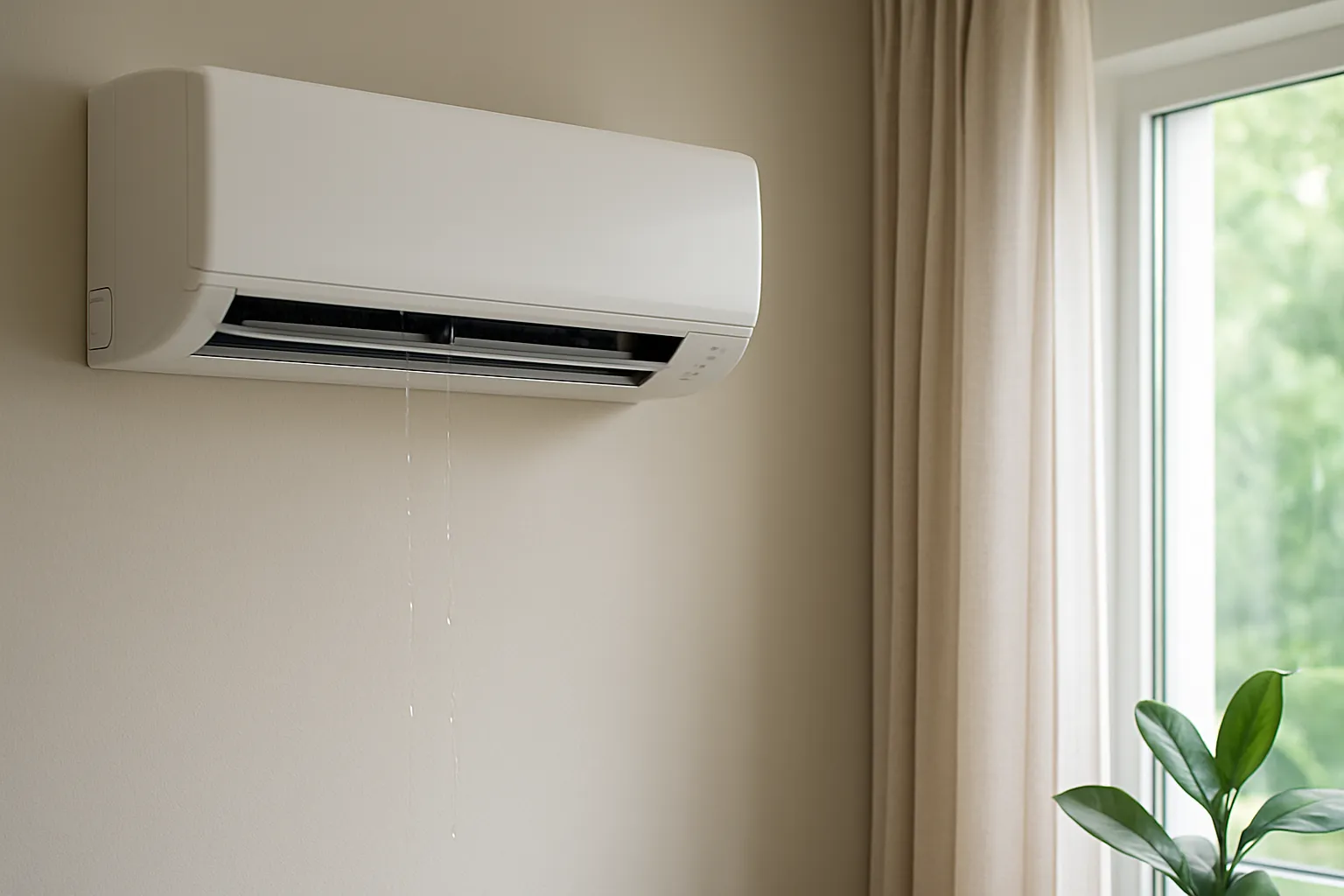
- Water is leaking from the indoor unit.
- The remote shows cooling mode, but the compressor does not start.
This matters because a dirty filter, low gas, capacitor failure, PCB fault, and undersized AC can all feel similar from inside the room. A correct diagnosis avoids unnecessary gas charging, part replacement, or buying a new AC too early.
Quick safety checks before opening anything
You can safely do basic checks, but avoid touching live wiring, capacitor terminals, refrigerant pipes, or PCB components. AC outdoor units can carry high voltage, and capacitors may hold charge even after switching off.
Safe checks for most users:
- Turn off the AC using the remote.
- Switch off power from the MCB or main switch before cleaning filters.
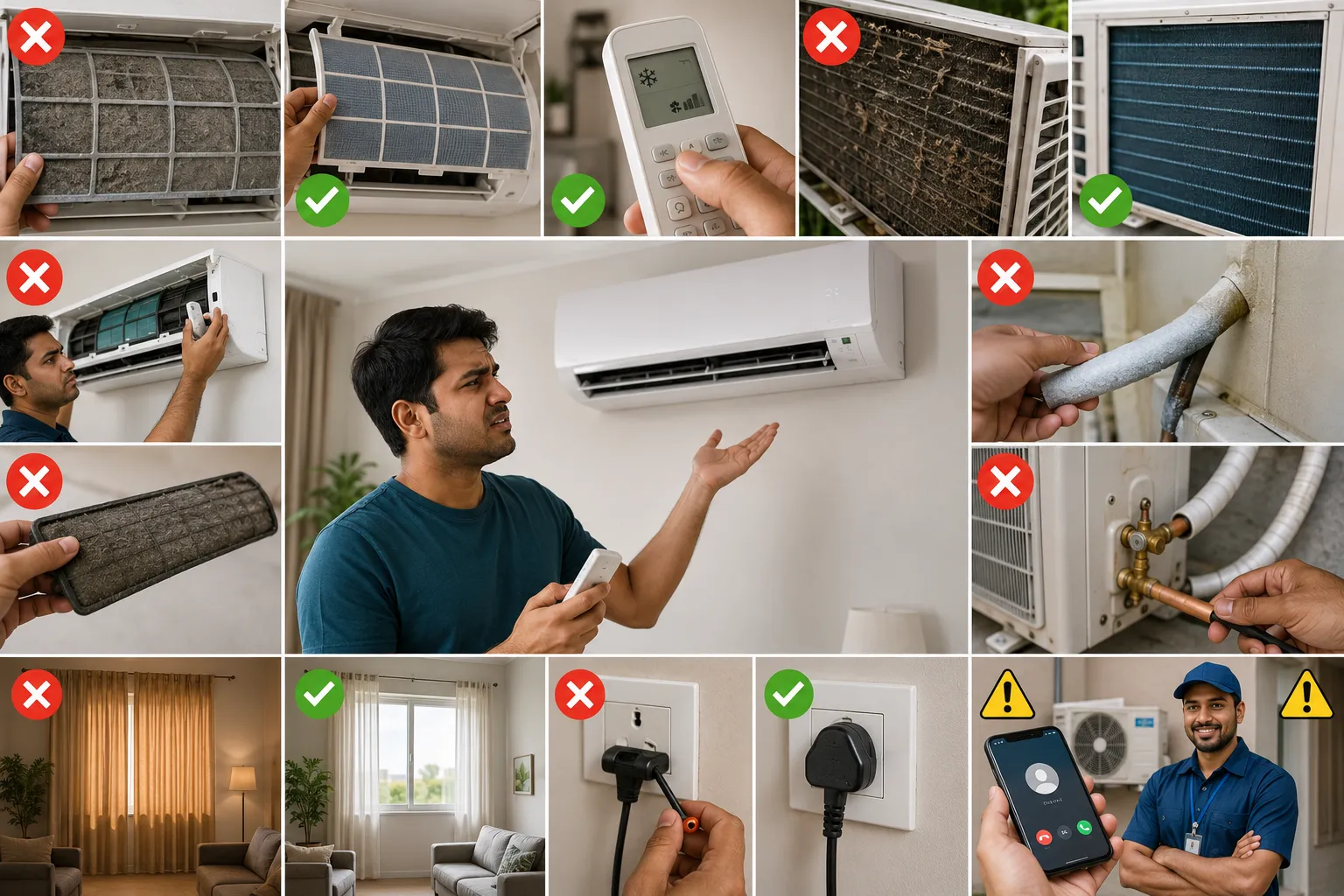
- Remove and wash only the user-removable filters if your model allows it.
- Keep the outdoor unit area clear without opening the electrical panel.
- Check remote batteries and settings.
- Restart the AC after 5 minutes, not immediately, to protect the compressor.
Call a professional if you notice burnt smell, repeated tripping, ice formation, oil stains near copper pipe joints, abnormal compressor noise, or no outdoor unit operation.
10 common reasons your AC is not cooling and how to fix them
1. Dirty air filter blocking airflow
This is the first thing to check. Indian homes often collect fine dust, cooking particles, pet hair, and pollution. In cities with construction dust, filters can clog within 2–4 weeks during summer.
When the filter is blocked, the indoor unit cannot pull enough warm room air through the cooling coil. The result is weak airflow, poor cooling, and higher electricity consumption.
What you can do:
- Open the front panel carefully.
- Remove the mesh filters.
- Wash with normal water and mild soap if required.
- Dry fully in shade before reinstalling.
- Do not run the AC without filters.
For homes using AC daily, clean filters every 15–30 days in peak summer. If the AC is in a kitchen-adjacent room or near a busy road, check more often.
2. Wrong mode or remote setting
It sounds basic, but many cooling complaints are caused by incorrect settings. If the AC is in fan mode, dry mode, eco mode, or set at 28–30°C, it may not cool the way you expect.
Check these settings:
- Mode should be “Cool” or snowflake symbol.
- Temperature should be around 24–26°C for regular use.
- Fan speed can be medium or high initially.
- Sleep mode may reduce cooling after some time.
- Timer may be switching the AC off.
If your AC has turbo mode, you can use it for the first 10–15 minutes in a very hot room, then switch back to normal cooling. Running turbo continuously may increase power use and noise.
3. Outdoor unit has poor ventilation
A split AC removes indoor heat and releases it outside through the outdoor unit. If the outdoor unit is trapped in a balcony corner, covered with a sheet, placed too close to a wall, or blocked by plants, the AC cannot reject heat properly.
This is common in apartments where the outdoor unit sits in a service shaft or enclosed balcony. In peak summer, the outdoor unit may overheat and cooling can drop sharply.
What to check:
- Is hot air from the outdoor fan able to escape freely?
- Is there at least reasonable open space around the unit?
- Is the unit covered by dust, leaves, or pigeon droppings?
- Is another outdoor unit blowing hot air directly into it?
Do not spray water into electrical areas. For heavy dirt on the condenser coil, book a professional wet service.
4. Low refrigerant or gas leakage
If the AC takes too long to cool, air is not cold enough, or ice forms on the indoor coil/copper pipe, low refrigerant may be the cause. However, refrigerant does not get “used up” like petrol. If gas is low, there is usually a leak.
Common leak points include flare joints, damaged copper pipes, indoor coil, outdoor coil, and service valves. Poor installation, sharp pipe bends, or vibration can make the problem worse.
Important: Do not accept gas charging without asking about leak checking. A quick refill may work for a few days or weeks, then the same problem returns.
Technicians may use pressure testing, soap solution, nitrogen testing, or electronic leak detectors depending on the situation. Repair cost depends on leak location and refrigerant type such as R32, R410A, or older R22 systems.
5. Dirty indoor cooling coil or blower
Even if the filter is clean, the evaporator coil and blower fan can collect sticky dirt over time. This reduces heat exchange and airflow. You may notice low air throw, bad smell, uneven cooling, or water dripping.
Basic filter cleaning is not the same as full indoor unit cleaning. A professional service may include coil cleaning, blower cleaning, drain tray cleaning, and drain pipe flushing.
In dusty Indian conditions, one pre-summer service is sensible for regularly used ACs. In coastal or high-pollution areas, more frequent servicing may be needed.
6. Faulty capacitor or outdoor fan problem
If the indoor unit runs but the outdoor unit does not start, the AC cannot cool. One common reason in non-inverter ACs is a weak or failed capacitor. The fan motor or compressor may struggle to start, make a humming sound, or shut down.
In inverter ACs, the diagnosis is different because the control board manages compressor speed. Problems may involve PCB, sensors, motor, or power supply.
User-level sign: You hear indoor airflow, but there is no warm air coming out of the outdoor unit. Cooling remains absent even after 10–15 minutes.
This is not a DIY repair. Capacitors and outdoor unit wiring can be dangerous. Call a technician and ask them to test before replacing parts.
7. Compressor not working properly
The compressor is the heart of the AC. If it fails to start or cannot maintain pressure, cooling will be poor or absent. Compressor issues can happen due to age, voltage fluctuation, overheating, gas leakage, poor installation, or electrical faults.
Signs may include:
- Outdoor fan runs but no cooling.
- Humming or clicking from the outdoor unit.
- MCB trips when compressor starts.
- Cooling works for a short time and stops.
- Error code on inverter AC display.
Compressor replacement is usually expensive. If the AC is under warranty, contact the brand-authorised service centre. For older units, compare repair cost with the value of a new BEE-rated inverter AC. A 10-year-old fixed-speed AC with major compressor repair may not be economical if energy consumption is also high.
8. Thermistor, sensor, PCB, or control issue
Modern ACs depend on sensors and control boards. If the room temperature sensor, coil sensor, communication wiring, or PCB has a fault, the AC may stop the compressor too early, show an error code, or run unpredictably.
This is more common in inverter ACs because they use more electronic control. Voltage fluctuation, moisture, insects, and poor earthing can damage PCBs.
What you can do:
- Note the exact error code from the indoor display.
- Check the manual or brand app if available.
- Switch off from the MCB for 5 minutes and restart once.
- If the error returns, call service.
Do not let anyone replace the PCB without checking sensors and wiring. PCB replacement can be costly, so proper diagnosis is important.
9. Drainage or icing problem reducing cooling
If water is dripping from the indoor unit or ice is forming, cooling performance will suffer. Ice can block airflow across the coil. Causes include dirty filters, low refrigerant, blocked coil, faulty fan motor, or very low temperature settings in humid conditions.
Drain problems are common during monsoon or in humid cities like Kolkata, Mumbai, Chennai, Kochi, and Guwahati. A blocked drain pipe can cause leakage inside the room.
Temporary step: Turn off cooling and run fan mode for some time to melt ice. Do not chip ice with sharp objects. If ice returns, call a technician.
10. Poor installation or wrong AC size
Sometimes the AC is not faulty at all. The installation or sizing is wrong.
Examples:
- A 1 ton AC installed in a large top-floor room with direct afternoon sun.
- Long copper piping without proper refrigerant adjustment.
- Poor vacuuming during installation leading to moisture in the system.
- Outdoor unit installed in a hot, enclosed shaft.
- Gaps around windows and doors allowing hot air entry.
- False ceiling heat load not considered.
For a rough Indian home estimate, a 1 ton AC often suits small rooms around 100–120 sq ft under moderate heat load. A 1.5 ton AC is commonly used for 130–180 sq ft rooms, but sun exposure, top floor, number of occupants, appliances, and insulation can change the requirement. A 2 ton AC may be needed for larger or very hot rooms. These are only broad ranges; a site check gives better accuracy.
AC not cooling diagnosis table
| Symptom you notice | Likely reason | Safe action you can take | When to call a technician |
|---|---|---|---|
| Airflow is weak | Dirty filter, dirty blower, blocked coil | Clean filters, keep vents open | If airflow stays weak after cleaning |
| Air is normal, not cold | Wrong mode, outdoor unit not running, gas issue | Check cool mode and temperature | If outdoor unit does not start |
| Ice on copper pipe or indoor coil | Low refrigerant, airflow blockage, coil issue | Switch off cooling, clean filter | If ice returns after restart |
| AC cools for 10 minutes then stops | Overheating, sensor issue, PCB fault, compressor protection | Check outdoor airflow and remote settings | If repeated stopping continues |
| Water leaks indoors | Drain blockage, dirty coil, poor slope | Switch off and check filter | If drain cleaning is required |
| MCB trips | Short circuit, compressor fault, wiring issue | Do not keep resetting repeatedly | Immediately, for electrical safety |
| Room never reaches set temperature | Undersized AC, heat leakage, dirty condenser | Seal room, clean filters, shade windows | If outdoor unit and service are due |
Approximate repair costs in India
Prices vary by city, season, brand, accessibility of outdoor unit, and refrigerant. Treat these figures as broad 2026 ranges, not fixed quotes.
| Service or repair | Approximate cost range | Notes |
|---|---|---|
| Basic split AC service | ₹500–₹1,200 | Filter, coil, and basic cleaning; city and brand dependent |
| Window AC basic service | ₹400–₹900 | Usually simpler access, but depends on installation |
| Deep cleaning / wet service | ₹800–₹1,800 | Useful for dirty coils and blower cleaning |
| Drain pipe cleaning | ₹300–₹800 | May be included in service visit |
| Capacitor replacement | ₹700–₹2,000 | Depends on rating and labour |
| Outdoor fan motor repair/replacement | ₹1,500–₹4,500+ | Brand and model specific |
| Gas leak detection and repair | ₹1,000–₹4,000+ | Coil leaks can cost much more |
| Gas charging | ₹2,000–₹5,500+ | Depends on tonnage and refrigerant type |
| PCB repair or replacement | ₹2,500–₹10,000+ | Inverter AC boards can be expensive |
| Compressor replacement | ₹7,000–₹18,000+ | Check warranty before approving |
During peak summer, emergency visits may cost more. If your AC is under brand warranty, avoid unauthorised work that can affect warranty claims.
When the issue is not a fault: tonnage, room heat, and expectations
A working AC can still feel weak if the room heat load is high. This happens often in Indian homes with west-facing walls, top-floor ceilings, large glass windows, poor curtains, or frequent door opening.
For example, suppose you use a 1.5 ton 3-star inverter AC in a 160 sq ft room in Pune or Kolkata. It may cool well at night but struggle at 3 pm if the room has direct sun and thin curtains. The AC may run continuously, but the room temperature drops slowly.
Check these heat load factors:
- Top floor under terrace without insulation.
- West or south-facing wall with direct sun.
- Large windows without blackout curtains.
- More than 3–4 people in the room.
- Gaming PC, large TV, or kitchen heat nearby.
- Door opened frequently.
- Air gaps around windows or balcony doors.
In such cases, servicing helps only if the unit is dirty or faulty. You may also need better curtains, door sealing, reflective film, terrace insulation, or a higher-capacity AC when replacing the unit.
How to reduce electricity bill while improving cooling
Better cooling does not always mean setting 18°C. In fact, setting 18°C in a hot room makes the compressor work harder and may increase electricity use without giving proportionate comfort.
Use these practical settings:
- Set 24–26°C for normal comfort.
- Use ceiling fan at low or medium speed along with AC.
- Close doors, windows, and exhaust openings.
- Use curtains before the room heats up, not after.
- Clean filters regularly.
- Do not block indoor air return with curtains or furniture.
- Keep outdoor unit ventilated.
A simple bill example: if an AC averages 1.2 kW while running and you use it 8 hours daily, daily use is about 9.6 units. At ₹8 per unit, that is about ₹77 per day, or around ₹2,300 per month. An inverter AC may draw less after the room stabilises, but actual savings depend on room heat, set temperature, usage hours, star rating, and maintenance.
BEE star rating matters more for long daily use. If you run an AC only 1–2 hours occasionally, paying much extra for a higher star rating may take longer to recover. If you run it 8–12 hours daily in summer, a higher ISEER model can make more sense.
What to ask a technician before approving repair
A good technician should explain the fault clearly and test before replacing parts. You do not need to understand every technical detail, but you can ask sensible questions.
Ask these before paying:
- What exact fault did you find?
- Did you check filter, coil, outdoor fan, compressor start, and gas pressure?
- If gas is low, where is the leak?
- Will you repair the leak before charging gas?
- Which refrigerant does my AC use: R32, R410A, or R22?
- Is the part original, compatible, or repaired?
- Is there any service warranty on the repair?
- Will this repair affect brand warranty?
- Can you show the old replaced part?
- Is the outdoor unit placement affecting cooling?
For inverter ACs from brands such as LG, Daikin, Voltas, Blue Star, Panasonic, Hitachi, Carrier, Samsung, or Lloyd, PCB and sensor issues can be model-specific. If the AC is new or under extended warranty, brand-authorised service is usually safer.
Practical next steps
- Set the AC to Cool mode, 24°C, medium/high fan, and wait 20 minutes.
- Clean the indoor filters after switching off power from the MCB.
- Check whether the outdoor unit fan is running and hot air is coming out.
- Remove obvious airflow blockage around indoor and outdoor units.
- Close windows, doors, curtains, and balcony gaps.
- If cooling is still poor, note symptoms: ice, error code, water leak, tripping, or outdoor unit silence.
- Call a technician for gas pressure testing, electrical testing, and deep cleaning if needed.
- Do not approve gas filling unless leak checking is discussed.
- Compare major repair cost with AC age, warranty, BEE star rating, and expected future use.
- After repair, run the AC for at least 20–30 minutes and confirm temperature drop before closing the job.
Conclusion
When your AC is not cooling, the right solution is not always gas charging. Start with simple checks—filter, mode, temperature, airflow, room sealing, and outdoor ventilation. If those are fine, move to professional diagnosis for refrigerant leak, fan motor, capacitor, compressor, PCB, or sensor issues.
For Indian homes, cooling performance depends on both machine health and room conditions. A clean, correctly sized, well-installed AC at 24–26°C usually gives better comfort per rupee than a neglected AC forced to run at 18°C. Use the checklist above to avoid unnecessary repair costs and restore cooling safely.
About the author
AC Kharcha Team — research-focused AC guides for India. We study AC usage patterns, electricity costs, product specifications, maintenance needs, and practical cooling decisions for Indian households.
Frequently asked questions
Why is my AC running but not cooling the room?
Common reasons include dirty filters, wrong remote mode, blocked outdoor unit airflow, low refrigerant due to leakage, dirty coils, faulty capacitor, compressor issue, or an undersized AC for the room. Start with filter and setting checks, then call a technician if cooling does not improve.
Does low gas always mean my AC needs refilling?
Low refrigerant usually means there is a leak. Refilling without leak detection may give temporary cooling, but the problem can return. Ask the technician to check for leakage before gas charging.
How often should I clean AC filters in India?
For daily summer use, clean filters every 15–30 days. Homes near construction sites, busy roads, pets, or kitchens may need more frequent cleaning. Always switch off power before removing filters.
What is the approximate cost to fix an AC not cooling in India?
Basic service may cost around ₹500–₹1,200, while gas charging with leak work can range from about ₹2,000–₹6,000 or more. PCB, compressor, and coil repairs can cost significantly more depending on brand, model, and city.
Can I run my AC if ice is forming on the copper pipe?
It is better to stop cooling and let the ice melt. Ice may be caused by low refrigerant, dirty filters, weak airflow, or coil problems. If ice returns after cleaning filters, call a technician.
Is 18°C the best setting when my AC is not cooling?
No. Setting 18°C usually makes the AC work harder and can increase electricity use. For most Indian homes, 24–26°C with a fan, clean filters, and a sealed room gives better comfort and efficiency.
When should I replace the AC instead of repairing it?
Consider replacement if the AC is very old, has repeated compressor or coil problems, uses high electricity, or the repair cost is a large part of a new BEE-rated inverter AC price. Check warranty status before deciding.
Last updated: 02 Sep, 2026 · Verified by editorial team
About the author
AC Kharcha Editorial Team
AC research & buying guides · India · We research air conditioners, electricity costs, and home cooling practices across Indian climates, then publish practical guides so households can buy and run ACs more confidently.
View all articles →Share this guide
Was this article helpful?