
LG AW-Q18WUZA 2026: 1.5T 5-Star Inverter Window AC Guide
LG AW-Q18WUZA 2026 is a 1.5-ton inverter window AC for homes where split AC installation is difficult. Check fit, sticker, costs, and bills before buying.
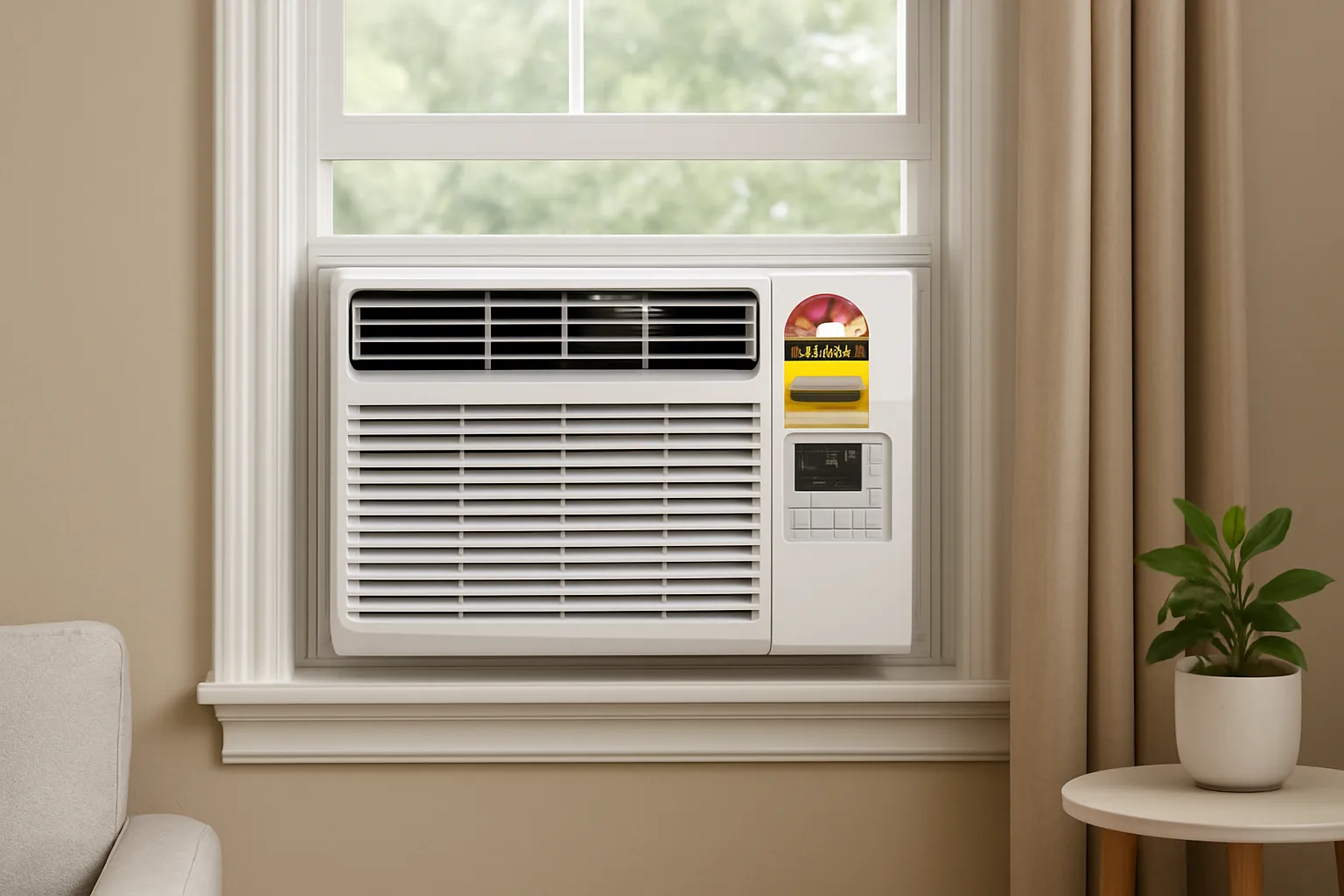
LG AW-Q18WUZA 2026: 1.5T 5-Star Inverter Window AC Guide
LG AW-Q18WUZA 2026 is a practical 1.5-ton inverter window AC for homes where split AC installation is difficult. If you have a proper window opening, want easier shifting later, and need a 2026 BEE label you can verify, it is worth a close look. Check the exact sticker, room size, window fit, and final installation charges before you pay.
Last updated: July 2026
Key takeaways
- LG positions the AW-Q18WUZA as a 2026 window AC with inverter technology, 5-star rating, and 1.5-ton class cooling.
- The model is listed with 5000 W rated cooling capacity and 1520 W rated power consumption, which directly affects room suitability and bill planning.
- LG’s 2026 BEE guidance says 5-star starts at ISEER 5.60 and above, so the sticker on the exact unit matters more than the headline claim.
- It is a sensible choice for renters, older flats, and homes where a split AC would require too much wall work.
- Window AC installation is usually simpler than split AC installation, but the final cost can still rise if the frame needs carpentry, reinforcement, or electrical upgrades.
- This model may suit a 150–170 sq ft room if the room has normal ceiling height and average heat load, though top-floor homes and harsh afternoon sun need extra checking.
- A realistic electricity estimate depends on run time, local tariff, sealing, and how hard the room has to fight outside heat.
Table of contents
- Why this LG window AC stands out in 2026
- Who should buy a window AC instead of a split AC
- LG AW-Q18WUZA specs and feature breakdown
- How to check the 2026 BEE sticker correctly
- Installation cost, fit, and renter concerns
- Estimated electricity bill in Indian homes
- Noise, airflow, and comfort in daily use
- Window AC vs split AC: which one makes more sense
- What to verify before ordering online
- Comparison table
- Conclusion
- About the author
Why this LG window AC stands out in 2026
The LG AW-Q18WUZA is not just another 1.5-ton AC with a premium label. It matters because it solves a very common Indian housing problem: many homes have space for a window AC, but not the freedom, budget, or building permission for a split AC.
That difference is huge in rental flats, older societies, and compact city homes. A split AC needs indoor-unit mounting, an outdoor unit, copper piping, and more installation work. A window AC is a single unit that sits in the window opening, which keeps the buying process far simpler. For many households, that simplicity is the real feature.
LG lists this model as a 2026 product with inverter operation, R32 refrigerant, and 4-way airflow support. The company also highlights 4-in-1 cooling, dehumidification, auto restart, clean filter indication, and stabilizer-free operation. On paper, that makes the AC more flexible than a basic fixed-speed window unit.
This is also an inverter-controlled window AC, not an old-style compressor that only runs at one speed. That means it can modulate output more intelligently than a basic on/off design. Do you want steadier comfort in the evening without harsh cycling? That is where inverter control helps most.
Who should buy a window AC instead of a split AC
A window AC makes sense when your room and housing situation matter more than the AC category itself.
It is a strong fit if you:
- live in a rented home and may shift in a few years,
- already have a solid window opening that can carry the unit,
- want to avoid wall drilling or outdoor-unit permissions,
- live in a building that does not allow visible split AC outdoor units, or
- want a simpler install process with less civil work.
A split AC may still suit you better if you:
- are buying for a long-term owned home,
- do not have a practical window slot,
- need a cleaner wall-mounted look,
- care most about lower indoor noise, or
- plan to keep the AC for many years and do not mind a harder setup.
For Indian renters, portability is the biggest window AC advantage. If you move, removal and reinstallation are often easier than shifting a split AC, though your next home still needs a suitable opening and frame. Why force a split AC setup if the room already supports a window unit cleanly?
LG AW-Q18WUZA specs and feature breakdown
Here are the specs that matter in real use, not just in marketing copy:
| Specification | Detail |
|---|---|
| Model | LG AW-Q18WUZA |
| Type | Window AC |
| Capacity class | 1.5 ton |
| Cooling capacity | 5000 W rated, 5680 W max |
| Rated power consumption | 1520 W |
| Compressor | Dual Inverter compressor |
| Refrigerant | R32 |
| Voltage | 230V / 50Hz |
| Approx. dimensions | 660 x 450 x 779 mm |
| Approx. weight | 48 kg |
| Airflow | 4-way airflow |
| Cooling modes | 4-in-1 cooling |
| Other features | Dehumidification, auto restart, clean filter indication, stabilizer-free operation |
A few numbers deserve extra attention.
Cooling capacity
The 5000 W rated cooling capacity puts this firmly in the 1.5-ton class. In practical terms, that band is usually suited to medium rooms, such as a bedroom or study in the roughly 150–170 sq ft range, assuming average ceiling height and not-too-extreme heat exposure.
Power consumption
The 1520 W rated cooling power consumption is the number you should start with for bill estimation. It does not mean the AC always draws that much every hour, because inverter operation adjusts output as the room cools. Even so, it is the right planning figure.
Physical size and weight
For a window AC, dimensions matter more than they do for many split AC buyers. At roughly 660 mm wide, 450 mm deep, and 779 mm high, with a weight around 48 kg, this unit needs a window frame that is both spacious and structurally sound. A weak frame can become noisy, unsafe, or awkward to service.
Noise and comfort
LG lists sound pressure as low as 40 dB(A) in the lowest cooling setting, with other lower-speed values also shown on the product page. That is useful, but actual noise depends heavily on mounting quality, room sealing, and how often the unit runs at full speed. Have you ever heard an AC sound louder only because the frame vibrated? That happens more often than people expect.
How to check the 2026 BEE sticker correctly
For 2026 buyers, the BEE sticker is not a formality. It is one of the most important pieces of purchase proof.
LG’s 2026 buying guidance says the star bands are:
| BEE stars | ISEER band |
|---|---|
| 1 star | 3.50–3.79 |
| 2 star | 3.80–4.29 |
| 3 star | 4.30–4.99 |
| 4 star | 5.00–5.59 |
| 5 star | 5.60 and above |
That means the seller’s headline alone is not enough. The exact label year, ISEER value, and annual energy consumption on the sticker should match what you are paying for.
Before payment, check these three things:
- Model number on the sticker matches the invoice and box.
- Label year matches the current 2026–2027 band.
- ISEER value sits in the 5-star range if the product is being sold as a 5-star AC.
Old inventory and new inventory can look similar online, but the label standard has changed. If the seller is not clear about the sticker, ask for a photo before confirming the order. Do not rely on the listing alone.
Installation cost, fit, and renter concerns
Window AC installation is usually less complex than split AC installation, but that does not mean there are no extra costs.
The AC itself may be straightforward to mount, yet the final bill can rise if you need:
- window frame repair,
- metal or wooden reinforcement,
- a better electrical socket,
- a dedicated MCB if the circuit is weak,
- drainage corrections,
- mounting accessories, or
- old-unit removal.
If your window frame is old, bent, or not designed to carry heavy weight, treat installation seriously. A 48 kg unit needs proper support. In many apartments, especially older ones, the frame is the hidden cost.
For renters, this is both an advantage and a caution. The advantage is that you usually avoid the invasive work required for a split AC. The caution is that the AC still becomes part of the window structure, so you should confirm whether the landlord allows visible changes.
Approximate install-cost checklist
| Item | Why it may add cost |
|---|---|
| Frame reinforcement | Needed if the window opening is weak |
| Electrical work | Needed if the existing socket is not suitable |
| Drain handling | Prevents water leakage and seepage |
| Removal of old AC | Adds labour if replacing a previous unit |
| Extra fitting material | Used for sealing, brackets, or support |
A window AC can still cost less to set up than a split AC, but only if the frame is decent and the electrical line is sound.
Estimated electricity bill in Indian homes
The simplest way to estimate electricity cost is to start with the rated input. LG lists 1520 W, which is 1.52 kW.
If the AC ran at rated load continuously, the rough consumption would be about 1.52 units per hour. In reality, inverter control can reduce this, especially once the room reaches the set temperature.
Here is a conservative planning table using the rated input:
| Daily use | Approx. monthly units | At ₹8/unit | At ₹9/unit | At ₹10/unit |
|---|---|---|---|---|
| 6 hours/day | 274 units | ₹2,192 | ₹2,466 | ₹2,740 |
| 8 hours/day | 365 units | ₹2,920 | ₹3,285 | ₹3,650 |
| 10 hours/day | 456 units | ₹3,648 | ₹4,104 | ₹4,560 |
These are planning figures, not guaranteed bills.
Your actual monthly cost can be lower if:
- the room is well sealed,
- you use a moderate set temperature,
- the AC spends more time at lower compressor output,
- you use it mainly at night, or
- you use sleep or convertible operation where appropriate.
Your bill can be higher if:
- the room gets direct afternoon sun,
- the top floor absorbs extra heat,
- the room is crowded,
- the door opens often, or
- humidity keeps the AC working longer.
If you use the AC mainly in summer, the annual spend may still feel reasonable. In that case, convenience and fit may matter as much as raw efficiency.
Noise, airflow, and comfort in daily use
People often compare ACs only by tonnage and star rating, but daily comfort also depends on airflow quality and installation quality.
The AW-Q18WUZA offers 4-way airflow, which should help distribute cooled air more evenly than a weak one-direction design. That is useful in Indian bedrooms where beds, study tables, or wardrobes may block direct airflow.
The 4-in-1 cooling feature is practical for homes that do not always need full-power cooling. You may prefer lighter operation on mild nights and stronger output during afternoon heat.
For monsoon use, the dehumidification mode can help a room feel less sticky without making it too cold. In humid cities, that can improve comfort even if the temperature setting is not very low.
Still, a window AC will feel different from a split AC:
- some installation noise is natural,
- the unit is visible in the window,
- sealing around the frame matters a lot, and
- the room may feel better if the unit is mounted level and tightly fixed.
If you want the quietest bedroom environment, a split AC may still have the edge. If you want the most practical install for a rental or older flat, this window unit remains a strong candidate.
Window AC vs split AC: which one makes more sense
| Factor | LG AW-Q18WUZA window AC | Typical 1.5-ton split AC |
|---|---|---|
| Installation effort | Lower if the window opening already exists | Higher, with outdoor unit and piping |
| Suitability for renters | Often better | Often less convenient |
| Visual impact | More visible in the room | Cleaner indoor appearance |
| Portability | Easier to move between homes | Harder to shift |
| Noise feel | Usually more noticeable | Often quieter indoors |
| Upfront site work | Usually simpler | Often more expensive |
A split AC may win on appearance and perceived quietness, but the window AC can win on practical ownership. For many Indian households, especially in older buildings, that is enough reason to choose it.
What to verify before ordering online
Before you buy, use a proper checklist instead of relying on the product title alone.
Online purchase checklist
- Confirm the exact model number: AW-Q18WUZA.
- Ask for a clear photo of the 2026 BEE sticker.
- Check the ISEER value and star band on the label.
- Measure the window opening and compare it with the unit size.
- Ask what installation includes: support work, drain handling, sealing, and test run.
- Confirm the return or replacement policy before installation begins.
- Check whether the home wiring is suitable for a high-load AC.
- If you are in a rental, get landlord approval for the visible window fit.
A quick site survey can save more trouble than a low listing price can save money. For window ACs, the real product is not only the machine; it is the machine plus the fit.
Comparison table
| Buying question | What to check | Why it matters |
|---|---|---|
| Is it the right size for my room? | Room area, sun exposure, ceiling height | A 1.5-ton unit may be right for 150–170 sq ft, but heat load changes the result. |
| Is the BEE label current? | 2026–2027 sticker, ISEER band, annual kWh | Star labels changed, so old stock should not be treated casually. |
| Will installation be simple? | Frame strength, socket quality, drainage | A weak frame or bad wiring can erase the convenience advantage. |
| Is it worth it for a renter? | Shift plans, landlord rules, removal ease | Portability is one of the biggest reasons to choose a window AC. |
| Is it better than a split AC? | Noise tolerance, install limits, budget | The right answer depends more on housing conditions than on brand alone. |
Conclusion
LG AW-Q18WUZA 2026 is a sensible option for Indian buyers who need strong 1.5-ton cooling but do not want the complexity of a split AC. Its biggest strengths are not just inverter technology and a 5-star position on paper. They are also the things that matter in real homes: simpler installation, easier movement, and less dependence on major civil work.
If your window opening is suitable, your wiring is sound, and the 2026 BEE sticker matches the listing, this model can be a practical, low-drama buy for a medium room.
About the author
AC Kharcha Team — research-focused AC guides for India. We study product specs, BEE labels, installation realities, and running-cost trade-offs so buyers can make clearer decisions in Indian homes.
Frequently asked questions
Is LG AW-Q18WUZA enough for a 150–170 sq ft room?
Yes, 1.5 ton is usually the right band for a 150–170 sq ft room if the ceiling height is normal and the room is not heavily exposed to afternoon sun. Top-floor heat, weak insulation, and frequent door opening can change the need, so measure the room and check the heat load before buying.
Is inverter window AC worth paying more for than a non-inverter window AC?
Usually yes if you run the AC for long hours, because inverter control can reduce compressor cycling and improve comfort. If you use the AC only very occasionally, the higher upfront cost matters more and the efficiency advantage may take longer to matter.
Can a tenant remove and reinstall this AC easily?
Usually yes, compared with a split AC, because it is a single window-mounted unit. The main condition is that the window frame should remain strong enough after removal and the next home should have a similar opening.
What should I check on the BEE sticker in 2026?
Check the label year, ISEER value, annual energy consumption, and whether the rating falls under the 2026–2027 bands. For a 5-star AC, LG’s 2026 guidance says the threshold starts at ISEER 5.60 and above.
Does 5-star still matter if I use the AC only three months a year?
Yes, but the financial benefit is smaller than for year-round use. In that case, convenience, installation simplicity, and room fit may matter just as much as the energy label.
Does this LG model need a stabilizer?
LG lists stabilizer-free operation for this model, but you should still check your home wiring, socket condition, and MCB protection with an electrician or installer.
Is the quoted price of around ₹41,490 final?
No. Street prices change by seller, city, and offers. Treat ₹41,490 as a July 2026 reference point, not a guaranteed final checkout price.
Last updated: 06 Sep, 2026 · Verified by editorial team
About the author
AC Kharcha Editorial Team
AC research & buying guides · India · We research air conditioners, electricity costs, and home cooling practices across Indian climates, then publish practical guides so households can buy and run ACs more confidently.
View all articles →Share this guide
Was this article helpful?
Related posts
 AC model reviews for Indian heat and tariffs
Whirlpool SAI17P56DET0 2026 Review: 5-Star AC for Dusty Tier-2 Homes?
A practical India-focused review of Whirlpool SAI17P56DET0 2026 for dusty Tier-2 and Tier-3 homes. See specs, likely bills, installation costs, and service fit.
 AC model reviews for Indian heat and tariffs
Samsung AR60H18D15W review: WindFree 5-star for Delhi heat
A practical 2026 review of Samsung AR60H18D15W for Delhi NCR homes, with verified specs, price context, bill math, and buying advice.
 AC model reviews for Indian heat and tariffs
Lloyd Stunnair GLS19V5ASOQZ 2026 Review: Is This ₹69k Air-Purifier AC Worth It?
A practical 2026 buyer guide to the Lloyd Stunnair GLS19V5ASOQZ 1.5 ton 5-star smart AC with built-in air purifier, Wi-Fi, voice control and premium pricing.